Showing posts with label google. Show all posts

Monday, September 17, 2018

History Of The Shawnee: Part 3

PART 3:
As published in the Official Newsletter of the Piqua Shawnee (Fall 2018)
By Barbara Lehmann, Piqua Shawnee Tribal Historic Preservation Officer
 
Barbara’s History Corner:
 
Bezallion informed the governor that the Shaonois of Carolina he was told had killed several Christians; whereupon the government of that province raised the said flat headed Indians, and joined some Christians to them, besieged and have taken, as it is thought, the said Shaonois town.” Those who escaped probably fled to the north and joined their kindred in Pennsylvania. In 1708 Gov. Johnson, of South Carolina, reported the “Savannahs” on Savannah River as occupying 3 villages and numbering about 150 men 6. In 1715 the “Savanos” still in Carolina were reported to live 150 miles northwest of Charleston, and still to occupy 3 villages, but with only 233 inhabitants in all.

A part of those who had come from the south in 1694 had joined the Mahican and become a part of that tribe. Those who had settled on the Delaware, after remaining there some years, removed to the Wyoming valley on the Susquehanna and established themselves in a village on the west bank near the present Wyoming, Pennsylvania. It is probable that they were joined here by that part of the tribe which had settled at Pequea, which was abandoned about 1730. When the Delawares and Munsee were forced to leave the Delaware River in 1742 they also moved over to the Wyoming valley, then in possession of the Shawnee, and built a village on the east bank of the river opposite that occupied by the latter tribe. In 1740 the Quakers began work among the Shawnee at Wyoming and were followed two years later by the Moravian Zinzendorf. As a result of this missionary labor the Shawnee on the Susquehanna remained neutral for some time during the French and Indian war, which began in 1754, while their brethren on the Ohio were active allies of the French. About the year 1755 or 1756, in consequence of a quarrel with the Delawares, said to have been caused by a childish dispute over a grasshopper, the Shawnee abandoned the Susquehanna and joined the rest of their tribe on the upper waters of the Ohio, where they soon became allies of the French. Some of the eastern Shawnee had already joined those on the Ohio, probably in small parties and at different times, for in the report of the Albany congress of 1754 it is found that some of that tribe had removed from Pennsylvania to the Ohio about 30 years previously, and in 1735 a Shawnee band known as Shaweygria (Hathawekela), consisting of about 40 families, described as living with the other Shawnee on Allegheny river, refused to return to the Susquehanna at the solicitation of the Delawares and Iroquois. The only clue in regard to the number of these eastern Shawnee is Drake’s statement that in 1732 there were 700 Indian warriors in Pennsylvania, of whom half were Shawnee from the south. This would give them a total population of about 1,200, which is probably too high, unless those on the Ohio are included in the estimate.

Having shown the identity of the Savannah with the Shawnee, and followed their wanderings from Savannah river to the Ohio during a period of about 80 years, it remains to trace the history of the other, and apparently more numerous, division upon the Cumberland, who preceded the Carolina band in the region of the upper Ohio river, and seem never to have crossed the Alleghanies to the eastward.
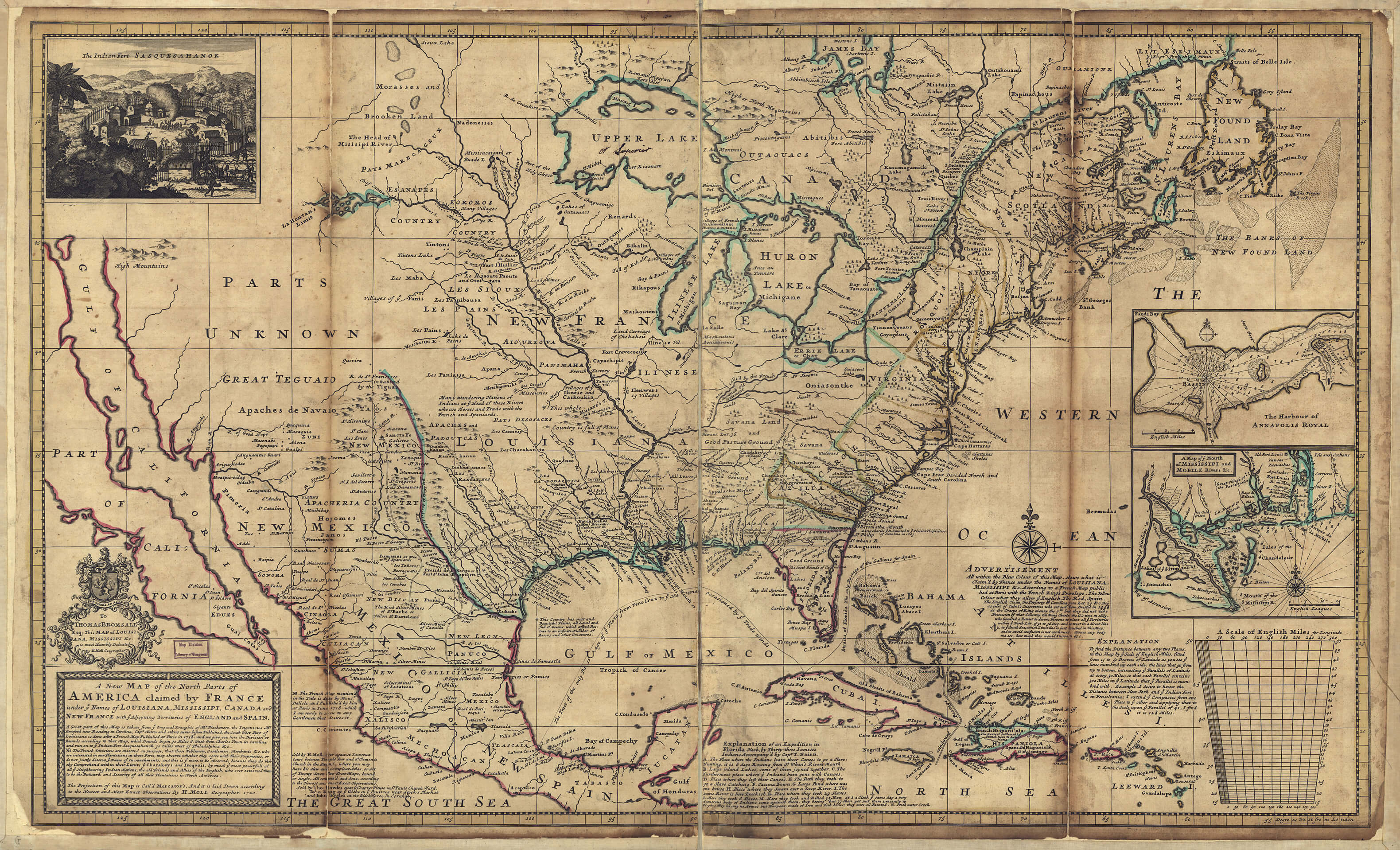
Moll-Map-of-1720-small
Moll’s map of 1720 has “Savannah Old Settlement” at the mouth of the Cumberland, showing that the term Savannah was sometimes applied to the Western as well as to the eastern band
These western Shawnee may possibly be the people mentioned in the Jesuit Relation of 1648, under the name of “Ouchaouanag,” in connection with the Mascoutens, who lived in northern Illinois. In the Relation of 1670 we find the “Chaouanon” mentioned as having visited the Illinois the preceding year, and they are described as living some distance to the south east of the latter. From this period until their removal to the north they are frequently mentioned by the French writers, sometimes under some form of the collective Iroquois name Toagenha, but generally under their Algonquian name Chaouanon. La Harpe, about 1715, called them Tongarois, another form of Toagenha. All these writers concur in the statement that they lived upon a large southern branch of the Ohio, at no great distance east of the Mississippi. This was the Cumberland River of Tennessee and Kentucky, which is called the River of the Shawnee on all the old maps down to about the year 1770.

 
When the French traders first came into the region the Shawnee had their principal village on that river near the present Nashville, Tennessee. They seem also to have ranged northeastward to Kentucky River and southward to the Tennessee. It will thus be seen that they were not isolated from the great body of the Algonquian tribes, as has frequently been represented to have been the case, but simply occupied an interior position, adjoining the kindred Illinois and Miami, with whom they kept up constant communication. As previously mentioned, the early maps plainly distinguish these Shawnee on the Cumberland from the other division of the tribe on Savannah River.

These western Shawnee are mentioned about the year 1672 as being harassed by the Iroquois, and also as allies and neighbors of the Andaste, or Conestoga, who were themselves at war with the Iroquois. As the Andaste were then incorrectly supposed to live on the upper waters of the Ohio River, the Shawnee would naturally be considered their neighbors. The two tribes were probably in alliance against the Iroquois, as we find that when the first body of Shawnee removed from South Carolina to Pennsylvania, about 1678, they settled adjoining the Conestoga, and when another part of the same tribe desired to remove to the Delaware in 1694 permission was granted on condition that they make peace with the Iroquois. Again, in 1684, the Iroquois justified their attacks on the Miami by asserting that the latter had invited the Satanas (Shawnee) into their country to make war upon the Iroquois. This is the first historic mention of the Shawnee evidently the western division in the country north of the Ohio River. As the Cumberland region was out of the usual course of exploration and settlement, but few notices of the western Shawnee are found until 1714, when the French trader Charleville established himself among them near the present Nashville. They were then gradually leaving the country in small bodies in consequence of a war with the Cherokee, their former allies, who were assisted by the Chickasaw. From the statement of Iberville in 1702 8 it seems that this was due to the latter’s efforts to bring them more closely under French influence. It is impossible now to learn the cause of the war between the Shawnee and the Cherokee. It probably did not begin until after 1707, the year of the final expulsion of the Shawnee from South Carolina by the Catawba, as there is no evidence to show that the Cherokee took part in that struggle.

From Shawnee tradition the quarrel with the Chickasaw would seem to be of older date. After the reunion of the Shawnee in the north they secured the alliance of the Delawares, and the two tribes turned against the Cherokee until the latter were compelled to ask peace, when the old friendship was renewed. Soon after the coming of Charleville, in 1714, the Shawnee finally abandoned the Cumberland valley, being pursued to the last moment by the Chickasaw. In a council held at Philadelphia in 1715 with the Shawnee and Delawares, the former, “who live at a great distance,” asked the friendship of the Pennsylvania government. These are evidently the same who about this time were driven from their home on Cumberland river.

To Be Continued Winter 2018
 
Piqua Shawnee Tribe
"Piqua Shawnee"


Friday, September 14, 2018

History Of The Shawnee: Part 2

PART 2:

As published in the Official Newsletter of the Piqua Shawnee (Fall 2018)

By Barbara Lehmann, Piqua Shawnee Tribal Historic Preservation Officer


Barbara’s History Corner:
On De l’Isle’s map, also, we find the Savannah River called “R.des Chouanons,” with the “Chaouanons” located upon bothbanks in its middle course. As to Gallatin’s statement that the name of the Savannahs is dropped after Lawson’s mention in 1701, we learn from numerous references, from old records, in Logan’s Upper South Carolina, published after Gallatin’s time, that all through the period of the French and Indian war, 50 years after Lawson wrote, the “Savannahs” were constantly making inroads on the Carolina frontier, even to the vicinity of Charleston. They are described as “northern savages” and friends of the Cherokee, and are undoubtedly the Shawnee. In
1749 Adair, while crossing the middle of Georgia, fell in with a strong party of “the French Shawano,” who were on their way, under Cherokee guidance, to attack the English traders near Augusta. After committing some depredations they escaped to the Cherokee. In another place he speaks of a party of “Shawano Indians,” who, at the instigation of the French, had attacked a frontier settlement of Carolina, but had been taken and imprisoned. Through a reference by Logan it is found that these prisoners are called Savannahs in the records of that period. In 1791 Swan mentions the “Savannas” town among the Creeks, occupied by “Shawanese refugees.” Having shown that the Savannah and the Shawnee are the same tribe, it remains to be seen why and when they removed from South Carolina to the north. The removal was probably owing to dissatisfaction with the English setters, who seem to have favored the Catawba at the expense of the Shawnee. Adair, speaking of the latter tribe, says they had formerly lived on the Savannah River, “till by our foolish measures they were forced to withdraw northward in defense of their, freedom.” In another place he says, “by our own misconduct we twice lost the Shawano Indians, who have since proved very hurtful to our colonies in general.” The first loss referred to is probably the withdrawal of
the Shawnee to the north, and the second is evidently their alliance with the French in consequence of the encroachments of the English in Pennsylvania.
Their removal from South Carolina was gradual, beginning about 1677 and continuing at intervals through a period of more than 30 years. The ancient Shawnee villages formerly on the sites of Winchester, Virginia, and Oldtown, near Cumberland, Maryland, were built and occupied probably during this migration. It was due mainly to their losses at the hands of the Catawba, the allies of the English, that they were forced to abandon their country on the Savannah; but after the reunion of the tribe in the north they pursued their old enemies with unrelenting vengeance until the Catawba were almost exterminated. The hatred cherished by the Shawnee toward the English is shown
by their boast in the Revolution that they had killed more of that nation than had any other tribe.
The first Shawnee seem to have removed from South Carolina in 1677 or 1678, when, according to Drake, about 70 families established themselves on the Susquehanna adjoining the Conestoga in Lancaster County, Pennsylvania, at the mouth of Pequea creek. Their village was called Pequea, a form of Piqua. The Assiwikales (Hathawekela) were a part of the later migration. This, together with the absence of the Shawnee names Chillicothe and Mequachake east of the Alleghanies, would seem to show that the Carolina portion of the tribe belonged to the first named divisions. The chief of Pequea was Wapatha, or Opessah, who made a treaty with Penn at Philadelphia in 1701, and more than 50 years afterward the Shawnee, then in Ohio, still preserved a copy of this treaty. There is no proof that they had a part in Penn’s first treaty in 1682.
In 1694, by invitation of the Delawares and their allies, another large party came from the south probably from Carolina and settled with the Munsee on the Delaware, the main body fixing themselves at the mouth of Lehigh river, near the present Easton, Pennsylvania, while some went as far down as the Schuylkill. This party is said to have numbered about 700, and they were several months on the journey. Permission to settle on the Delaware was granted by the Colonial government on condition of their making peace with the Iroquois, who then received them as “brothers,” while the Delawares acknowledged them as their “second sons,” i. e. grandsons. The Shawnee today refer to the Delawares as their grandfathers. From this it is evident that the Shawnee were never conquered by the Iroquois, and, in fact, we find the western band a few years previously assisting the Miami against the latter. As the Iroquois, however, had conquered the lands of the Conestoga and Delawares, on which the Shawnee settled, the former still claimed the prior right of domain. Another large part of the Shawnee probably left South Carolina about 1707, as appears from a statement made by Evans in that year 5, which shows that they were then hard pressed in the south. He says: “During our abode at Pequehan [Pequea] several of the Shaonois Indians from ye southward came to settle here, and were admitted so to do by Opessah, with the governor’s consent, at the same time an Indian, from a Shaonois town near Carolina came in and gave an account that four hundred and fifty of the flat headed Indians [Catawba] had besieged them, and that in all probability the same was taken.
To Be Continued
Piqua Shawnee Tribe
"Piqua Shawnee"

Tuesday, September 11, 2018

Bluejacket Carved Walking Stick


Walking stick

Walking Stick

Shawnee tribal leader Charles Bluejacket carved this walking stick for his friend Charles Boles, a Methodist missionary, in the mid- to late-19th century. The two met in Kansas in the early 1850s, when the church assigned Boles to preach to the Shawnee tribe.

A deep friendship took root between two men in the wilds of Kansas. Their bond spanned the differences of culture and race, and lasted a lifetime. Today we often think of encounters between whites and American Indians on the frontier as tense, even violent. This was not always the case. The likelihood that individuals would get along depended on their personalities and as well as the circumstances under which they interacted. In this regard, Bluejacket and Boles may have been predisposed to friendship. Both men were deeply religious. They fathered large families, and lived respectable lives by European-American standards.

Charles Bluejacket came to Kansas as a youth after a treaty with the United States government removed the Shawnees from Ohio and Missouri. His grandfather was the famous chief Bluejacket, and his grandmother probably was white. Charles was familiar with Indian missions, having attended a Quaker school in Ohio. In Kansas, he completed his education at another mission school. He married, became a successful farmer and interpreter for the federal government, and began leading a prayer group.

Charles Boles converted to Methodism as a young man in Missouri and was ordained an elder in 1851. The following year he was assigned to the Shawnee Indian Mission School in present-day Kansas City. It was during his six-year ministry to the tribe that he became friendly with Bluejacket.

Shawnee Methodist Mission

Conditions were primitive at many frontier missions, but not at Shawnee Indian Mission. The Methodist church considered it an exemplary site, as did the federal government (a major funding source). At its height, the mission occupied almost 2,000 acres, much of it farmland. Its grounds had brick schoolhouses and dormitories, workshops, and farm buildings. Because the Methodists used "circuit riders" (traveling ministers) to spread the gospel, Shawnee Mission was Boles' headquarters, although he spent most days in the field ministering to his flock.

Charles BluejacketCharles BolesDetails on the friendship between Boles and Bluejacket are spotty, but the two men obviously saw each other frequently and perhaps even rode the circuit together. One early visitor to the area noted that he met Bluejacket and Boles at another missionary's home in 1857. The Methodist conference minutes for this time period record that Boles was "assisted" by Bluejacket and others in building the church rolls to about 100 Shawnees.

The six years Boles preached to the Shawnee tribe coincided with the Bleeding Kansas era, when violence exploded along the Kansas-Missouri border. It became extremely difficult to accomplish any missionary work. The Methodist conference minutes for this period note, "There was comparatively little done from 1855 to 1865. During these perilous years Bro. Boles stood almost alone." Almost alone, but not quite. His friend Bluejacket had become an ordained minister in 1859. When war made it impossible for whites to preach at Shawnee Mission, Bluejacket became missionary in charge.

A number of mission schools closed during the Civil War, including Shawnee Mission. Methodists continued to preach to the tribes remaining in Kansas, but most American Indians were removed to Indian Territory (present-day Oklahoma) shortly after the war. Boles began preaching to non-Indian Methodists in eastern Kansas. Bluejacket became a prosperous farmer, despite the fact that many of his fellow tribesmen had moved south. An 1874 county atlas describes his "beautiful farm" and house "furnished in a style that would do credit to many of our wealthy people."

Bluejacket eventually joined his tribesmen in Indian Territory, but before he left he made this elaborate walking stick for Boles. Its carved figures include at least two motifs from the pillars of an early Shawnee council-house in Kansas--a rattlesnake and a turtle, the latter being prominent in Shawnee creation mythology. View a close-up of the turtle carving. The walking stick was passed down in the Boles family until the Kansas State Historical Society acquired it in 2009. It is in the collections of the Society's Kansas Museum of History.

https://www.kshs.org/kansapedia/walking-stick/10388

Entry: Walking Stick
Author: Kansas Historical Society
Author information: The Kansas Historical Society is a state agency charged with actively safeguarding and sharing the state's history.
Date Created: July 2009
Date Modified: December 2014

Piqua Shawnee
Piqua Shawnee Tribe

Tuesday, December 12, 2017

Blackfish (c. 1729-1779) Shawnee Leader

Blackfish (c. 1729-1779) Shawnee Leader


https://en.wikipedia.org/wiki/Blackfish_(Shawnee_leader)

Little is known about him, since he only appears in written historical records during the last three years of his life, primarily because of his interactions with the famous American frontiersmen Daniel Boone and Simon Kenton.

When the Shawnees were defeated by Virginia in Dunmore's War in 1774 , the resulting peace treaty made the Ohio River the boundary between western Virginia (what is now Kentucky and West Virginia) and American Indian lands in the Ohio Country. Although this treaty was agreed to by Shawnee leaders such as Cornstalk, Blackfish and a number of other leaders refused to acknowledge the loss of their traditional hunting grounds in Kentucky.

Violence along the border escalated with the outbreak of the American Revolutionary War in 1775. As a result, the Chillicothe Shawnees moved their town on the Scioto River further west to the Little Miami River, near what is now Xenia, Ohio. Encouraged and supplied by British officials in Detroit, Blackfish and others launched raids against American settlers in Kentucky, hoping to drive them out of the region. In revenge for the murder of Cornstalk by American militiamen in November 1777, Blackfish set out on an unexpected winter raid in Kentucky, capturing American frontiersman Daniel Boone and a number of others on the Licking River on February 7, 1778. Boone, respected by the Shawnees for his extraordinary hunting skills, was taken back to Chillicothe and adopted into the tribe. The traditional tale is that Boone was adopted by Blackfish himself, although historian John Sugden suggests that Boone was probably adopted by another family.

Boone escaped in June 1778 when he learned that Blackfish was launching a siege of the Kentucky settlement of Boonesborough, which commenced in September of that year. The siege of Boonesborough was unsuccessful, and the Kentuckians, led by Colonel John Bowman, counterattacked Chillicothe the following spring. This raid was also unsuccessful, but Blackfish was shot in the leg, a wound which became infected and was eventually fatal.

References

  • Faragher, John Mack. Daniel Boone: The Life and Legend of an American Pioneer. New York: Holt, 1992.
  • Lofaro, Michael. Daniel Boone: An American Life. Lexington, KY: University Press of Kentucky, 2003.
  • Sugden, John. "Blackfish" in American National Biography. Oxford University Press, 1999.

Piqua Shawnee
www.piquashawnee.com

Friday, October 13, 2017

Shawnee Traditions By C.C. Trowbridge

Shownese Traditions. C. C. TROWBRIDGE, Edited by VERNON KLNIETZ and ERMINIE W. VOEGELIN. (Occasional Contributions from the Museum of Anthropology of the University of Michigan, No. 9, 71 pp. Ann Arbor, 1939.) 

Excerpt:
This volume is the second to be published of the early nineteenth century manuscripts of C. C. Trowbridge on the ethnology of the tribes of the old Northwest.' Trowbridge as the secretary of Governor Lewis Cass, for whom he collected information on the manners and traditions of the natives of the Great Lakes and the Ohio Valley.

The accounts of the Shawnee are two in number, the originals having only recently been found in the possession of Trowbridge's Grandson, Mr Sydney Trowbridge Miller of Detroit. One account was taken down in July 1824 at an interview near Detroit with the notable Shawnee, the Prophet; the other and shorter account being written in 1825 at the Shawnee Reservation at Wapakoneta, Ohio, from the mouth of the aged chief, Black Hoof.

The text is a faithful verbatim copy of the manuscript. This publication contains a wealth of very valuable ethnological information and much historical data of importance. It is excellently edited, here being an appropriate introduction by Dr Erminie Voegelin, and the book is adequately annotated with illuminating footnotes, marked for their ethnological and historical accuracy. The authoritative weight of the book is augmented by the fact the Shawnee informants were among the best obtainable. The Prophet wa? the brother of the famous Shawnee leader, Tecumseh, and himself a shaman with the sanction of supernatural revelations, and the pre-eminent champion and exponent of cultural conservatism among the tribes of the then Northwest. Both belonged to the KiSpoko division of the Shawnee. The other informant, Black Hoof, then in his nineties, was a prominent Shawnee warrior and chief, probably belonging to the Oawikila division.

Brief mention should be made of some of the more salient features of the volume. Elderly matrons or “peace women” could appeal to the war chiefs to stop warfare and prevent the unnecessary effusion of blood (p. 12), a trait also found in more or less modified form among the Delaware, Iroquois and Penobscot. There is a most impressive complete list of the thirty-four patrilineal sibs or gentes of the Shawnee tribe (pp. 16-17), many of which were at that time extinct (1824). Nine of these are to be found in Lewis H. Morgan’s list of Shawnee gentes collected in 1860 in Kansas. The Shawnee can be viewed as an enclave of Central Algonkian patrilineal descent persisting in an area dominated by mother-right in the form of the southern and eastern tribes among whom they wandered and lived so long. Some specific functions of the gentes are mentioned. The war chief was always a member of the Panther gens; and warriors of the Panther gens always followed at the rear of the party in returning from the warpath, while warriors of the Wolf gens led at the head (p. 19). The guardians of the sacred fire were two men, one of the Panther gens and one of the Turtle gens, one belonging to the CalakaaOa (Chillicothe) and one to the Mekore division (p.56). The sacred fire complex is a Characteristic Southeastern cultural trait which the Shawnee probably adopted during their long period of southern residence. Pyrolatry reached its fullest development among the Creek, Natchez and Taensa, but undoubtedly extended to other groups in more or less attenuated form. A Shawnee version of the primeval deluge or Earth-diver tale is given (p. 60) in which the crawfish is the animal agent, which is in agreement with the Southeastern and Gulf tribes (Creek, Yuchi, etc.), in contrast to most Central Algonkian tribes who have the muskrat as the animal helper. Of considerable interest is the cannibal or anthropophagic society of the Shawnee which is found also among the Miami and Kickapoo. Male and female members of the society were admitted by hereditary descent, and all belonged to the Pekowi (Piqua) division of Shawnee. The heads of the society were four women who claimed all the prisoners of war they could seize, the unfortunates subsequently being burned alive and eaten by the society (pp. 53-4, p. 64). The Shawnee make offerings of tobacco to their grandfathers, the snakes, upon their appearance every spring (pp. 42,48) in contradistinction to the practice of other Algonkian tribes. The Penobscot, Delaware, Sauk and Fox, all make offerings to their grandfathers, the Thunderers, when a storm approaches by casting tobacco in the fire, the Thunderers being the traditional enemies of all serpents and water monsters.However, the Fox are on record for making offerings of tobacco to both serpents and Thunderers.

It is a matter of note that in tabulating the cultural elements of a society, negative findings are equally important. Some specific denials for the Shawnee are found in the absence of wampum commemorative and record belts (p. 9), the lack of an organized medicine society such as occurred among the Ojibwa and Iroquois (p. 38), and the absence of transvestism (p.65), which is reported to have been present among the Delaware, Miami, and Potawatomi, and is known in the Southwest among the Navaho, Zuni, etc. No doubt this book will serve to fill many lacunae when the final detailed portrayal of Shawnee ethnology is presented by Drs Charles and Erminie Voegelin. Criticism is uncalled for, beyond stating that an index would have enhanced the usefulness of the volume.

MERION, PENNSYLVANIA FRANK T, SIEBERT, JR

Visit www.piquashawnee.com
Piqua Shawnee

Thursday, October 12, 2017

CNN: Looking for Native American culture in the U.S.? Here's where to go.


TRAVEL: Looking for Native American culture in the U.S.? Here's where to go.

Dana Joseph, for CNN • Updated 12th May 2015

(CNN) — Think Native American culture has been co-opted by casinos, twisted by inaccurate films, relegated to the rez or buried with arrowheads? No chance.
American Indian culture is alive and thriving in modern galleries, powwows, museum exhibits, film festivals and restaurants.

Here are some of the best places in the United States to experience Native America (arranged in a roughly east-to-west geographic order).

1.    George Gustav Heye Center (New York)

The George Gustav Heye Center in New York is part of the National Museum of the American Indian.

"The Heye Center began as the personal collection of George Gustav Heye, a wealthy investment banker who collected nearly a million items that became the largest collection of American Indian items in the world," says NMAI director Kevin Gover (Pawnee).
Heye's will stipulates that his collection always be made available to the people of New York, and since 1994, it's been on view for all to see in Lower Manhattan across from Battery Park, in the historic Alexander Hamilton U.S. Custom House.
Highlights of the collection include 10 headdresses from different Native tribes and duck decoys from Lovelock Cave, Nevada (at ca. 400 B.C.-A.D. 100, they're the oldest known in the world). Nursing moms will especially appreciate the Yup'ik jacket that holds junior on Mom's back till feeding time, when the jacket can be ingeniously turned forward.

Elsewhere in New York City, which, by the way, has the largest indigenous population of any city in the country, the Queens County Farm Museum holds the Thunderbird American Indian Mid-Summer Pow Wow, the city's largest and oldest (July 25-27, 2014).


2. National Museum of the American Indian (D.C.)


The National Museum of the American Indian is the Smithsonian Institution's great national repository of American Indian art and culture on the National Mall.
"Our world-class collection covers cultures from North, Central and South America and totals more than 800,000 items," says museum director Kevin Gover. "Our Mitsitam Native Foods Cafe was the first Zagat-rated museum cafe in Washington and has a devoted following."
The museum presents a full calendar of public programs, including concerts, festivals, symposiums and theater, along with one-of-a-kind temporary exhibitions featuring the likes of esteemed Native artists such as Fritz Scholder, George Morrison, Brian Jungen and Allan Houser.
It's Native inside and out: the design of the grounds has reintroduced a landscape indigenous to the Washington area before "contact."
3. Oklahoma 

You might know it as the Sooner State, but the state name Oklahoma is Indian, from the Choctaw words "okla" and "humma," meaning "red people."The entire state is rich with American Indian culture. Makes sense: Oklahoma has 39 federally recognized tribes and the second greatest percentage of Native Americans in the country.If you know about the forced removal of the Cherokee in 1838-1839 along the Trail of Tears (now a National Historic Trail) to reservations in Indian Territory in what is now southeastern Oklahoma, you'll appreciate Tahlequah, the capital of the Cherokee Nation. At the Cherokee Heritage Center there's a re-created ancient Cherokee village and a permanent Trail of Tears exhibit.You can tour the Tahlequah Original Historic Townsite District, where the street signs are written in English and Cherokee. More Cherokee-related museums include the John Ross Museum, the John Hair Museum and Cultural Center and the Cherokee Supreme Court Museum.In Muscogee, you can learn about the art, culture and history of the Five Civilized Tribes (the term refers to the tribes considered most able to assimilate: the Cherokee, the Choctaw, Muscogee/Creek, Chickasaw and Seminole) at the Five Civilized Tribes Museum.In the Osage Hills, 10 minutes from downtown Tulsa, the acclaimed Gilcrease Museum houses the world's largest, most comprehensive collection of art and artifacts of the American West and an unparalleled collection of Native American art and artifacts.You'll want to allow time for the museum and its acres of gardens.
Painted drum at the Red Earth Festival.
In Oklahoma City, lots of the almost 40,000 indigenous residents turn out for the three-day Red Earth Festival every June (in 2014, June 5-7).
It kicks off with a parade and keeps right on kicking with dancing, singing, storytelling, poetry, music and art.
In Shawnee, The Jim Thorpe Native American Games bring together athletes representing 70 different tribes from across the country.
The Games honor Jim Thorpe (Sac and Fox), the athletic legend who was born in Indian Territory near the town of Prague, Oklahoma, and went on to become a pro baseball player, pro football player and an Olympic Gold medalist in record-setting wins of the pentathlon and decathlon in the 1912 Olympics.
Inaugurated in 2012 to honor the man often called The Greatest Athlete of the 20th Century, the Native Games host thousands of athletes competing in 10 sports. The 2014 Games will be held in Shawnee June 8-14. And coming to Oklahoma City in 2017, the $10 million American Indian Cultural Center and Museum.

4. Santa Fe, New Mexico

Experiencing Santa Fe's rich American Indian culture requires more than a couple of days -- and many return trips.
American Indian vendors line the historic Plaza, selling authentic silver and turquoise jewelry and other Native crafts.
Galleries like Shiprock on the Plaza, Blue Rain on Lincoln and the many along Canyon Road are a gateway to a life-altering addiction to Native arts, from painting and sculpture, to textiles, pottery and jewelry.
For a one-fell-swoop approach, you can hit Santa Fe during August's world-renowned Indian Market, when the parking is horrible but the historic center overflows with booths devoted to Native arts and eats.
"This is the biggest and the best venue for we Native American artists," says sculptor Upton Greyshoes Ethelbah (Apache). "Collectors arrive for the two-day show by the tens of thousands (estimates range from 80,000 to 100,000).
"Visitors to the Santa Fe Indian Market are treated to the best diverse Native American art in the country, with over 10 different classifications, from stone and bronze sculpture, which is my specialty, to pottery, beadwork, jewelry, painting, weaving and even filmmaking."
The Indian Market is an opportunity to share cultures not only with visitors unfamiliar with Native differences, but among different tribes as well.
"There are over 562 different tribal groups in the U. S. with different languages, ceremonies and traditions," he says. "Everyone benefits by experiencing the great variation of artwork that emerges from these many tribes and nations. Virtually every individual item offered to the collector by over a thousand Indian artists originates in tribal tradition or symbology, and artists are eager to share with the collector the inspiration and the historical or spiritual meaning of their work."
The Inn and Spa at Loretto is an architectural re-creation of the famed Taos Pueblo.
As soon as you see it, you'll know why it's one of the most photographed buildings in the country.

5. Gathering of Nations (Albuquerque, New Mexico)
The fourth weekend of April, Native America flocks to Albuquerque for the Gathering of Nations.
Billed as the world's largest Native American cultural event, it's a tribal extravaganza in all its flying fringe and bodacious beading.
Where else but North America's most prominent powwow are you going to find the crowning of Miss Indian World and more than 700 tribes doing their thing?
"The Gathering of Nations strives to be a positive cultural experience that is exhilarating for everyone," says Derek Mathews, founder of the event, which marked its 31st year in 2014. "The powwow features thousands of dancers performing different styles from many regions and tribes, offers the finest in Native American arts and crafts in the Indian Traders Market, a delicious variety of Native American and Southwest cuisine and the best in contemporary entertainment performances."
The Grand Entry is special -- thousands of Native American dancers simultaneously enter the University of New Mexico's arena in full regalia to the beating of hundreds of drums.
Between Albuquerque and Santa Fe, the Hyatt Regency Tamaya Resort and Spa is located on the sacred lands of the Santa Ana Pueblo.
The resort offers golf, pools, spa, restaurants and all the usual upscale amenities but distinguishes itself with American Indian cultural experiences.
There are Pueblo bread-baking demonstrations by tribal members using a traditional oven called a huruna, flute and tribal dance performances on certain weekends, a cultural museum with personal tours hosted by a tribal member, hiking and riding (horses or bikes) through cottonwoods along the Rio Grande on trails used by the Tamayame people for centuries and creation stories told under the stars by a Native American storyteller (followed by s'mores).
In the city, you can stay at the funky, artsy Nativo Lodge (American Indian meets modern meets retro boutique hotel/motel) and make an extra day of the Indian Pueblo Cultural Center and Petroglyph National Monument. 

6. Taos, New Mexico

Taos is crazy with galleries and museums highlighting Native American culture.
The Millicent Rogers Museum is one of the best -- it houses important collections of Native American arts, including pottery and jewelry.
Just outside of town is the Taos Pueblo -- a settlement of adobe dwellings and ceremonial buildings that dates to the late 13th century, the pueblo is still a living community.
It's both a UNESCO World Heritage Site and a National Historic Landmark and open to the public for guided walking tours, shopping and fry bread eating. (Check ahead for hours and entry fee.)
The Rio Grande Gorge is located just outside of Taos. You can cross the famous long-span bridge over the incredible 600-foot-deep gorge.

7. Shiprock, New Mexico/Monument Valley

With more than 17 million acres, the Navajo Nation encompasses the entire northeast quarter of Arizona, and spills into New Mexico and Utah.
Shiprock, which is much easier to pronounce than its Navajo name, Tsé Bitʼaʼí, is located in the northwest corner of New Mexico. The "rock with wings" or "winged rock," which is said to have brought tribes here from the north, rises 1,583 feet from the plain and looks every foot the sacred and mythological heavyweight it is in Navajo culture.
The approach is practically a religious experience. From Shiprock, it's two-and-a half-hour drive to Monument Valley, on the Arizona-Utah border.
One of the world's most famous film locations for its miles and miles of mesas, buttes and rock spires sculpted by eons of water and wind, Monument Valley is also a tribal park of the Navajo Nation.
The 17-mile scenic drive takes in Mitten Buttes, Merrick Buttes and other iconic formations. Navajo guides (compulsory if you want to get off the road) can take you into some of the park's 92,000 acres.
At the Navajo-staffed The View Hotel you can watch the sun rise over the Mittens.

8. Phoenix

Arizona is home to 22 federally recognized tribes, and Native history and landmarks are found throughout the state, from "Sky Island" mountains and rock formations in Chiracahua National Monument to urban centers like Phoenix, which is home to almost 45,000 indigenous people.
Haven't heard of The Heard? As in the Heard Museum? It's only one of the Phoenix area's earliest and best cultural attractions, and a terrific destination for learning about American Indian arts and cultures.
"The Heard Museum offers a unique and memorable visitor experience with 11 galleries that present the best of American Indian traditional and contemporary art," says museum director of curation and education Ann Marshall. "Within a year, six to eight new exhibits are presented, so return visits always bring something new.
The museum's annual Indian Fair and Market in March (Arizona's largest) features more than 700 Native artists.
Just outside of downtown Phoenix, the Pueblo Grande Museum and Archaeological Park sits on a 1,500-year-old site, which includes a short trail through a prehistoric Hohokam archaeological village complete with a partially excavated platform mound, ball court and replicated prehistoric houses.
In December, an Indian Market features music and dance performances, artist demonstrations, children's crafts and, naturally, fry bread.
Arizona is home to a number of highly regarded American Indian restaurants.
As a 2013 Boston Globe story noted, "Talented [Native] chefs are returning to local, old-fashioned ingredients (think tepary beans, Saguaro cactus seeds, sumac and chollo buds) and adding creative twists to the traditional dishes of indigenous peoples, spurring a hot, new culinary trend."
The Globe's three top recommendations for American Indian dining in Phoenix: the Fry Bread House, which, despite being "no-frills," was "one of only five restaurants nationwide to win the 2012 James Beard American Classics Award, and the only Native American restaurant ever to receive it"; the "five-star, five diamond" KAI; and the "health-focused" Desert Rain Café.

9. Mesa Verde (Colorado)

The ancestral Puebloans who lived at Mesa Verde from A.D. 600 to 1300 left behind some of the best-preserved sites in the country.
An interpretive tour of their ancient cliff dwellings and mesa-top sites is the way to get the most out of this stunning setting. Afterward, you can get a nice meal with an incomparable view at the lodge's Metate Room restaurant.
With rooms starting at $106, the Far View Lodge inside the national park has spectacular vistas and stargazing opportunities.

10. Denver, Colorado


The Denver Art Museum is internationally known for its holdings of American Indian art, with permanent collections and exhibitions showing everything from ancient ceramics to 19th-century Arapaho beaded garments to contemporary glasswork.
The museum puts on the Friendship Powwow and American Indian Cultural Celebration, which celebrates its 25th year in September 2014.
There are American Indian dancers, drum groups, artists, vendors, and, need we say it, fry bread.
The Mile High City is also home to the Denver March Powwow -- second largest indoor powwow after Albuquerque's Gathering of Nations -- celebrating its 40th year March 20-22, 2015, at the Denver Coliseum.
Who cooks all the Indian tacos at the Denver March Powwow?
It just might be Tocabe: An American Indian Eatery -- you can try their tacos anytime at Tocabe's Denver restaurant.
Partners Ben Jacobs and Matt Chandra call it "fast, casual," sort of the community-minded Chipotle of Native American food. The shredded bison American Indian taco is a fan favorite. Bison ribs is another signature dish.
"We're trying to showcase American Indian cuisine in the 21st century," Chandra says. "This is food that speaks to tradition but also shows that it can progress and have the ability to adapt and become a part of mainstream cuisine."

11. Crow Fair (Montana)

Parade cars draped in serape blankets and 1,500 tepees under Montana's Big Sky -- it could only be Crow Fair.
Every third week of August, Crow Agency (60 miles south of Billings off I-90) becomes the Tepee Capital of the World when it hosts the largest modern-day American Indian encampment in the nation, and the largest gathering of the year for the Apsaalooke Nation.
Daily parades, evening powwows, All Indian rodeo, Indian relay horse races, the closing Dance Through Camp -- the Crow Fair is a week of incredible displays of Native American culture.
Attractions in the area include Little Bighorn Battlefield National Monument (where the Sioux and Cheyenne famously defeated the U.S. Army's 7th Cavalry); Custer Battlefield Museum; and Bighorn Canyon National Recreation Area (must-do: Devil's Canyon Overlook). 

12. American Indian Film Festival (San Francisco)

Seeing American Indian life through the lens of Native filmmakers is one of the best ways to understand the modern Native experience.
One of the best places to do that (aside from the indie film category on Netflix) is the American Indian Film Festival in San Francisco.
It's the mission of the American Indian Film Institute to empower American Indian media artists, and the AIFI's annual film festival has been bringing Native stories to a growing audience for nearly 40 years.
"There are other American Indian film festivals around the country," says festival founder and president Michael Smith. "But the AIFI festival in San Francisco is the longest-running and has the most content. Last year, there were more than 85 films."
The 39th annual American Indian Film Festival takes place November 1-9, 2014.
If you're lucky, you might catch filmmaker Chris Eyre (Cheyenne, Arapaho), an AIFI and Sundance favorite since his debut film, "Smoke Signals," won honors at both festivals in 1998.
It's hard to imagine from modern American Indian film subjects and the festival's Bay Area setting that the lands south of the Golden Gate Bridge were once home to the Ohlone, or Costanoan, tribe, and north of the bridge, especially in what's now Marin County, to the Miwok tribe.
For a small taste of what the region was like when American Indians inhabited it centuries before high-tech modernity, you can visit the Marin Museum of the American Indian in Novato's Miwok Park.
It's on the site of an actual Miwok village, in a peaceful and pristine setting that's about as far from the influence of Silicon Valley as you can get in these parts.

13. The Salish Sea (Pacific Northwest)


As much as it might now be about coffee and grunge culture, the Pacific Northwest is also formline art, totem pole, longhouse and dugout canoe country.
Puget Sound, the Strait of Juan de Fuca and the Strait of Georgia are all part of the Salish Sea.
You could do all sorts of things in the region to get a feel for the richness of its tribal past.
Blake Island has its Tillicum Village, where you can take in a Northwest Coast Indian dance performance with a traditional salmon bake dinner.
You can pay your respects at Chief Seattle's gravesite and learn about the longhouse tradition in Suquamish, Washington, on the Port Madison Indian Reservation, where the great chief lived and died.
And you can immerse yourself in the history and culture of the Puget Sound Salish Tribes (particularly the Suquamish) at the new and niftily designed Suquamish Museum and Cultural Center.
Just across the water/border in Vancouver, Canada, you can get intensely ethnographic at University of British Columbia's Museum of Anthropology with its a vast collection of Aboriginal art and artifacts, including traditional canoes, masks, jewelry, carvings, longhouse replicas and totem poles.
Not to be outdone, the Royal BC Museum in Victoria on nearby Vancouver Island has one of the most comprehensive collections of First Nations cultural material, from ceremonial and utilitarian objects to artistic masterworks.
Back in Vancouver's Stanley Park, there are the much-visited totem poles, tribal dance performances, Aboriginal foods and storytelling, a Spirit Catcher Train through the forest and activities at the Klahowya Aboriginal Village.
There's more to experience at Capilano Suspension Bridge Park, where you can top off First Nations cedar chiseling demonstrations, Totem Park, and the displays and weaving and beadwork demonstrations at Kia'palano First Nations cultural center with views of the Pacific Northwest rainforest from the bridge over the Capilano River. 
Dallas-based Dana Joseph is the editorial director of Cowboys & Indians magazine.

Piqua Shawnee
www.piquashawnee.com