Showing posts with label Shawnees. Show all posts

Monday, December 18, 2017

Tecumseh Quote

Tecumseh -

Shawnee Quote

So live your life that the fear of death can never enter your heart. 
Trouble no one about their religion; respect others in their view, and 
demand that they respect yours. Love your life, perfect your life, beautify 
all things in your life. Seek to make your life long and its purpose in the service
of your people. 

Prepare a noble death song for the day when you go over the great divide. 
Always give a word or a sign of salute when meeting or passing a friend, even 
a stranger, when in a lonely place. Show respect to all people and grovel to none. 
When you arise in the morning give thanks for the food and for the joy of living. 

If you see no reason for giving thanks, the fault lies only in yourself. Abuse 
no one and no thing, for abuse turns the wise ones to fools and robs the 
spirit of its vision. 

When it comes your time to die, be not like those whose 
hearts are filled with the fear of death, so that when their time comes they 
weep and pray for a little more time to live their lives over again in a different way. 

Sing your death song and die like a hero going home.


Piqua Shawnee

Friday, December 15, 2017

Organizer of Indian Confederation - Tecumseh

Organizer of Indian confederation - Tecumseh

With inexhaustible energy, Tecumseh began to form an Indian confederation to resist white pressure. He made long journeys in a vast territory, from the Ozarks to New York and from Iowa to Florida, gaining recruits (particularly among the tribes of the Creek Confederacy, to which his mother’s tribe belonged). The tide of settlers had pushed game from the Indians’ hunting grounds, and, as a result, the Indian economy had broken down.
In 1811, while Tecumseh was in the South, William Henry Harrison, governor of the Indiana Territory, marched up the Wabash River and camped near the brothers’ settlement. The Prophet unwisely attacked Harrison’s camp and was so decisively defeated in the ensuing Battle of Tippecanoe that his followers dispersed, and he, having lost his prestige, fled to Canada and ceased to be a factor in Tecumseh’s plans.
Seeing the approach of war (the War of 1812) between the Americans and British, Tecumseh assembled his followers and joined the British forces at Fort Malden on the Canadian side of the Detroit River. There he brought together perhaps the most formidable force ever commanded by a North American Indian, an accomplishment that was a decisive factor in the capture of Detroit and of 2,500 U.S. soldiers (1812).
Fired with the promise of triumph after the fall of Detroit, Tecumseh departed on another long journey to arouse the tribes, which resulted in the uprising of the Alabama Creeks in response to his oratory, though the Chickasaws, Choctaws, and Cherokees rebuffed him. He returned north and joined the British general Henry A. Procter in his invasion of Ohio. Together they besieged Fort Meigs, held by William Henry Harrison, on the Maumee River above Toledo, where by a stratagem Tecumseh intercepted and destroyed a brigade of Kentuckians under Colonel William Dudley that had been coming to Harrison’s relief. He and Procter failed to capture the fort, however, and were put on the defensive by Oliver Hazard Perry’s decisive victory over the British fleet on Lake Erie (September 10, 1813). Harrison thereupon invaded Canada. Tecumseh with his Indians reluctantly accompanied the retiring British, whom Harrison pursued to the Thames River, in present-day southern Ontario. There, on October 5, 1813, the British and Indians were routed, and Harrison won control of the Northwest. Tecumseh, directing most of the fighting, was killed. His body was carried from the field and buried secretly in a grave that has never been discovered. Nor has it ever been determined who killed Tecumseh. Tecumseh’s death marked the end of Indian resistance in the Ohio River valley and in most of the lower Midwest and South, and soon thereafter the depleted tribes were transported beyond the Mississippi River.
Glenn Tucker
 
www.Britannica.com
https://www.britannica.com/biography/Tecumseh-Shawnee-chief#ref252112

Piqua Shawnee
www.Piquashawnee.com

Monday, November 27, 2017

Tecumseh (U.S. National Park Service)


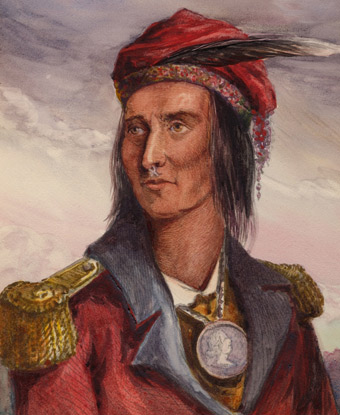
Portrait of Shawnee chief Tecumseh
Portrait of Shawnee chief Tecumseh based on sketch by Benson John Lossing
Attributed to Owen Staples

Quick Facts

Significance:Shawnee leader
Place of Birth:Scioto River, Ohio
Date of Birth:March 9, 1768
Place of Death:Chatham-Kent, Canada
Date of Death:October 5, 1813
Tecumseh began life in the Shawnee village of Piqua, Ohio on March 9, 1768 as a great meteor flashed and burned its way across the heavens. This event accounts for his name: The Shooting Star, or Celestial Panther Lying in Wait. Tecumseh grew to be a famous warrior and dynamic orator. These skills, paired with his belief that the white man would never rest until all American Indians were dispossessed, made him a powerful and influential force.

Tecumseh conceived of an alliance of all remaining native people, from Canada to the Gulf of Mexico, from the prairies of the Midwest to the swamplands of Florida. All Indian people would set aside their ancestral rivalries and unite into a single movement to defend their culture, their homelands, and their very lives.

Providing spiritual impetus for Tecumseh's movement was the teaching of his younger brother, known as Tenskwatawa, The Open Door, or The Prophet. In 1808, the Shawnee brothers established a new capital on the banks of the Wabash and Tippecanoe rivers, while Tecumseh traveled extensively in an effort to build his alliance. 

In the summer of 1811 Tecumseh traveled south to meet with the Creek, Chickasaw, and Choctaw people. The Shawnee leader had promised a sign of his power, and as he arrived in Alabama a huge comet appeared, brightening the skies and fading after his departure. Then, shortly after he left for Prophetstown, a series of violent earthquakes arched out of their epicenter in southeastern Missouri to destroy lives and property throughout the midwest and south. In the minds of the Creek and many others, Tecumseh had made good on his promises.

Meanwhile, growing tensions between the U.S. and Great Britain exploded into war. Tecumseh saw the War of 1812 as his final opportunity to construct an independent Indian nation. He journeyed to Canada in July of 1812 and forged an alliance with the British. General Isaac Brock placed Tecumseh in command of all Native American forces with the understanding that, should the British and Indians be victorious, the Old Northwest would comprise an independent Indian nation under British protection.

Despite a number of victories, this partnership turned fatal on October 5, 1813, at the Battle of the Thames River. Outnumbered three-to-one by General William Henry Harrison's army, the Indian and British forces were overwhelmed, without fortifications, and ultimately doomed.
Tecumseh's vision of a unified American Indian homeland was never fully realized. Within 35 years of Tecumseh's death at Moraviantown, many Native nations east of the Mississippi River were forcibly relocated. But today the great Tecumseh is still revered for his intelligence, leadership, and military skills, and he is honored throughout North America.


Read more about Tecumseh:

https://www.nps.gov/people/tecumseh.htm

www.piquashawnee.com

Piqua Shawnee


Tuesday, November 21, 2017

The Shawnees and the War for America by Colin Calloway (Author)


With the courage and resilience embodied by their legendary leader Tecumseh, the Shawnees waged a war of territorial and cultural resistance for half a century. Noted historian Colin G. Calloway details the political and legal battles and the bloody fighting on both sides for possession of the Shawnees? land, while imbuing historical figures such as warrior chief Tecumseh, Daniel Boone, and Andrew Jackson with all their ambiguity and complexity. More than defending their territory, the Shawnees went to war to preserve a way of life and their own deeply held vision of what their nation should be.


Editorial Reviews

From Publishers Weekly

In placing the Shawnee center stage, Calloway (editor of the Penguin Library of American Indian History and Dartmouth Native American studies chair) achieves a remarkably accessible distillation of Shawnee history. He guides the reader through a thicket of wandering as the Shawnees' forced movement scatters them from the Ohio Valley during the late 17th century, before they reassembled in Ohio in the mid-18th century, and then gathered again in Oklahoma in the 19th century. The Shawnees stand out as hard liners when it came to defending Native lands, Native rights, and Native ways of life, says Calloway. Indeed, their history is a cycle of killings and revenge killings, battles and massacres by both sides, swallowing up those who made accommodations (Black Hoof and the model farm at Wapakoneta) as well as those who resisted (the legendary brothers, Tenskwatawa and Tecumseh). Daniel Boone, who played a key role in destroying the Shawnees' world in Kentucky, is part of that history, as is General Amherst, who advocated using germ warfare. The treks and treaties are not always easy reading, but Calloway's text is enlivened with judicious first-person excerpts and his passion for his subject. His heart is with the Shawnees, but he writes with balance of the fateful meeting of the cultures on the frontiers. (July)
Copyright © Reed Business Information, a division of Reed Elsevier Inc. All rights reserved. --This text refers to an out of print or unavailable edition of this title.

  • Paperback: 256 pages
  • Publisher: Penguin Books; Reprint edition (June 24, 2008)
  • Language: English
  • ISBN-10: 0143113917
  • ISBN-13: 978-0143113911
Available on Amazon.com 

Visit Piqua Shawnee at www.piquashawnee.com 

Tuesday, November 14, 2017

Shawnee - Prehistory

Shawnee - Prehistory

Fort Ancient Monongahela cultures by Herb Roe
Fort Ancient Monongahela cultures by Herb Roe 
Some scholars believe that the Shawnee are descendants of the people of the precontact Fort Ancient culture of the Ohio region, although this is not universally accepted.[5][6][7] Fort Ancient culture flourished from 1000 to 1650 CE among a people who predominantly inhabited lands along the Ohio River in areas of southern Ohio, northern Kentucky and western West Virginia. They were mound builders. Fort Ancient culture was once thought to have been an extension of the Mississippian culture. But, scholars now believe Fort Ancient culture developed independently and was descended from the Hopewell culture (100 BCE—500 CE), also a mound builder people.

Serpent Mound, Peebles, Ohio
Serpent Mound, Peebles, Ohio 
Uncertainty surrounds the fate of the Fort Ancient people. Most likely their society, like the Mississippian culture to the south, was severely disrupted by waves of epidemics from new infectious diseases carried by the first Spanish explorers in the 16th century.[8] After 1525 at Madisonville, the type site, the village's house sizes became smaller and fewer, with evidence showing the people changed from their previously "horticulture-centered, sedentary way of life".[8][9]
There is a gap in the archaeological record between the most recent Fort Ancient sites and the oldest sites of the Shawnee. The latter were recorded by European (French and English) explorers as occupying this area at the time of encounter. Scholars generally accept that similarities in material culture, art, mythology, and Shawnee oral history linking them to the Fort Ancient peoples can be used to support the connection from Fort Ancient society and development as the historical Shawnee society.[10]

The Shawnee traditionally considered the Lenape (or Delaware) of the East Coast mid-Atlantic region, who were also Algonquian speaking, as their "grandfathers." The Algonquian nations of present-day Canada regarded the US Shawnee as their southernmost branch. Along the East Coast, the Algonquian-speaking tribes were mostly located in coastal areas, from Quebec to the Carolinas.
Algonquian languages have words similar to the archaic shawano (now: shaawanwa) meaning "south". However, the stem šawa- does not mean "south" in Shawnee, but "moderate, warm (of weather)": See Voegelin "šawa (plus -ni, -te) MODERATE, WARM. Cp. šawani 'it is moderating...".[11] In one Shawnee tale, "Sawage" (šaawaki) is the deity of the south wind.[12] Curtin translates Sawage as 'it thaws', referring to the warm weather of the south. šaawaki is attested as the spirit of the South, or the South Wind, in this account, in one of Voegelin's tales,[13] and in a song collected by Voegelin.[14]

Read more:
http://www.wikiwand.com/en/Shawnee#/Prehistory

Piqua Shawnee
www.piquashawnee.com

Tuesday, October 31, 2017

Tecumseh, Treaty of Fort Wayne and the Comet of 1811

Tecumseh, Treaty of Fort Wayne and the Comet of 1811


In September 1809 William Henry Harrison, then governor of the Indiana Territory, invited the Potawatomi, Lenape, Eel River people, and the Miami to a meeting in Fort Wayne, Indiana. In the negotiations, Harrison promised large subsidies and payments to the tribes if they would cede the lands he was asking for.[29] After two weeks of negotiating, the Potawatomi leaders convinced the Miami to accept the treaty as reciprocity, because the Potawatomi had earlier accepted treaties less advantageous to them at the request of the Miami. Finally the tribes signed the Treaty of Fort Wayne on September 30, 1809, thereby selling the United States over 3,000,000 acres (approximately 12,000 km²), chiefly along the Wabash River north of Vincennes, Indiana.[29]
Tecumseh was outraged by the Treaty of Fort Wayne, believing that American Indian land was owned in common by all tribes, an idea advocated in previous years by the Shawnee leader Blue Jacket and the Mohawk leader Joseph Brant.[30] In response, Tecumseh began to expand on the teachings of his brother, known as The Prophet, who called for the tribes to return to their ancestral ways. He began to associate the teachings with the idea of a pan-tribal alliance. Tecumseh traveled widely, urging warriors to abandon the accommodationist chiefs and to join the resistance at Prophetstown.[30]
In August 1810, Tecumseh led 400 armed warriors to confront Governor Harrison in Vincennes. Tecumseh demanded that Harrison nullify the Fort Wayne treaty, threatening to kill the chiefs who had signed it.[31] Harrison refused, stating that the Miami were the owners of the land and could sell it if they so chose.[32] Tecumseh left peacefully, but warned Harrison that he would seek an alliance with the British unless the treaty was nullified.[33]


The Great Comet of 1811, as drawn by William Henry Smyth


In March the Great Comet of 1811 appeared. During the next year, tensions between American colonists and Native Americans rose quickly. Four settlers were murdered on the Missouri River and, in another incident, natives seized a boatload of supplies from a group of traders. Harrison summoned Tecumseh to Vincennes to explain the actions of his allies.[33] In August 1811, the two leaders met, with Tecumseh assuring Harrison that the Shawnee intended to remain at peace with the United States.

Afterward Tecumseh traveled to the Southeast on a mission to recruit allies against the United States among the "Five Civilized Tribes." His name Tekoomsē meant "Shooting Star" or "Panther Across The Sky."[34] He told the Choctaw, Chickasaw, Muscogee, and many others that the comet of March 1811 had signaled his coming. He also said that the people would see a sign proving that the Great Spirit had sent him.


While Tecumseh was traveling, both sides readied for the Battle of Tippecanoe. Harrison assembled a small force of army regulars and militia in preparation to combat the Native forces.[35] On November 6, 1811, Harrison led this army of about 1,000 men to Prophetstown, Indiana, hoping to disperse Tecumseh's confederacy.[36] Early next morning, forces under The Prophet prematurely attacked Harrison's army at the Tippecanoe River near the Wabash. Though outnumbered, Harrison repulsed the attack, forcing the Natives to retreat and abandon Prophetstown. Harrison's men burned the village and returned home.[37] This was the end of Tecumseh's dream of a united native alliance against the whites.

On December 11, 1811, the New Madrid earthquake shook the Muscogee lands and the Midwest. While the interpretation of this event varied from tribe to tribe, they agreed that the powerful earthquake had to have meant something. The earthquake and its aftershocks helped the Tecumseh resistance movement as the Muscogee and other Native American tribes believed it was a sign that the Shawnee must be supported and that this was the sign Tecumseh had prophesied.


The New Madrid earthquake was interpreted by the Muscogee as a reason to support the Shawnee resistance.

Piqua Shawnee
 

Wednesday, October 18, 2017

What are some traditional Shawnee Indian food recipes?


Shawnee cakes and three sisters soup are some traditional recipes from the Shawnee Indians. Variations of these recipes were used by Native American tribes throughout North America and were also adapted by European settlers.

The exact origin of Shawnee cakes is unknown, but some historians believe the dish originally belonged to the Shawnee people. These simple fried corn cakes, also known as Johnny cakes and hoe cakes, are still widely consumed, particularly in the southeast and New England. One cup of cornmeal, 1 1/2 cups of boiling water and a pinch of salt are the basic ingredients, although some modern recipes substitute 1/2 cup of milk. Fry spoonfuls of the batter in a heavy skillet until crisp and golden brown on both sides.

Like many Native American tribes, the Shawnees depended on farming as an essential part of their food supply. Corn, beans and squash, or the three sisters, were a significant part of their cuisine and their culture. Combine 2 cups of canned hominy, 2 cups of trimmed green beans, 2 cups of cubed butternut squash and 1 1/2 cups of diced potatoes in a large stock pot with 5 cups of water and 1 1/2 tablespoons of chicken bouillon granules. Bring the mixture to a boil, and then simmer on low heat for 10 minutes. Stir 2 tablespoons of melted butter into 2 tablespoons of flour, add it to the soup, and cook over medium heat for five minutes.

Sources:

Visit the Official Website of the Piqua Shawnee

Monday, October 16, 2017

The Treaty of Fort Wayne (1809)

The Treaty of Fort Wayne (1809)

Tecumseh's War
The two principal adversaries in the conflict, chief Tecumseh and American politician William Henry Harrison, had both been junior participants in the Battle of Fallen Timbers at the close of the Northwest Indian Wars in 1794. Tecumseh was not among the Native American signers of the Treaty of Greenville, which had ended the war, when the Shawnee and other Native Americans ceded much of their historic territory in present-day Ohio to the United States. However, many Indian leaders in the region accepted the Greenville terms, and for the next ten years pan-tribal resistance to American hegemony faded.


The Treaty of Fort Wayne, sometimes called the Ten O'clock Line Treaty or the Twelve Mile Line Treaty, is an 1809 treaty that obtained 3,000,000 acres (approximately 12,000 km²) of American Indian land for the white settlers of Illinois and Indiana. The tribes involved were the Delaware, Eel River, Miami tribe, and Potawatomi in the initial negotiations; later Kickapoo and the Wea, who were the primary inhabitants of the region being sold. The negotiations did not include the Shawnee who were minor inhabitants of the area purchased and had been asked to leave the area previously by Miami War Chief Little Turtle. Territorial Governor William Henry Harrison negotiated the treaty with the tribes. The treaty led to a war with the United States began by Shawnee leader Tecumseh and other dissenting tribesmen in what came to be called "Tecumseh's War".

Tecumseh was outraged by the Treaty of Fort Wayne, believing that American Indian land was owned in common by all tribes, an idea advocated in previous years by the Shawnee leader Blue Jacket and the Mohawk leader Joseph Brant.[30] In response, Tecumseh began to expand on the teachings of his brother, known as The Prophet, who called for the tribes to return to their ancestral ways. He began to associate the teachings with the idea of a pan-tribal alliance. Tecumseh traveled widely, urging warriors to abandon the accommodationist chiefs and to join the resistance at Prophetstown.[30]

Negotiations

The treaty also has two nicknames, the "Ten O'clock Line Treaty of 1809" and the "Twelve Mile Line Treaty". The first nickname comes from tradition that says the Native Americans did not trust the surveyors' equipment, so a spear was thrown down at ten o'clock and the shadow became the treaty line. There are other myths that say it was either a tree or a fence that was used. The Twelve Mile Line was a reference to the Greenville Treaty and the establishment of a new 'line' parallel to it but twelve miles further west.

In 1809 Harrison began to push for a treaty to open more land for settlement. The Miami, Wea, and Kickapoo were "vehemently" opposed to selling any more land around the Wabash River.[1] In order to influence those groups to sell the land, Harrison decided, against the wishes of President James Madison, to first conclude a treaty with the tribes willing to sell and use them to help influence those who held out. In September 1809 he invited the Pottawatomie, Lenape, Eel Rivers, and the Miami to a meeting in Fort Wayne. In the negotiations Harrison promised large subsidies and payments to the tribes if they would cede the lands he was asking for.[2]
 
Only the Miami opposed the treaty. They presented their copy of the Treaty of Greenville and read the section that guaranteed their possession of the lands around the Wabash River. They then explained the history of the region and how they had invited the Wea and other tribes to settle in their territory as friends. The Miami were concerned the Wea leaders were not present, although they were the primary inhabitants of the land being sold. The Miami also wanted any new land sales to be paid for by the acre, and not by the tract. Harrison agreed to make the treaty's acceptance contingent on approval by the Wea and other tribes in the territory being purchased, but he refused to purchase land by the acre. He countered that it was better for the tribes to sell the land in tracts so as to prevent the Americans from only purchasing their best lands by the acre and leaving them only poor land to live on.[2]

After two weeks of negotiating, the Pottawatomie leaders convinced the Miami to accept the treaty as reciprocity to the Pottawatomie who had earlier accepted treaties less advantageous to them at the request of the Miami. Finally the Treaty of Fort Wayne was signed on September 29, 1809, selling United States over 3,000,000 acres (approximately 12,000 km²), chiefly along the Wabash River north of Vincennes.[2] During the winter months, Harrison was able to obtain the acceptance of the Wea by offering them a large subsidy and the help of Miami Chief Pacanne who helped to influence the Wea leaders. The Kickapoo were closely allied with the Shawnee at Prophetstown and Harrison feared they would be difficult to sway. He offered the Wea an increased subsidy if the Kickapoo would also accept the treaty, causing the Wea to pressure the Kickapoo leaders to accept. By the spring of 1810 Harrison had completed negotiations and the treaty was finalized.[3]

Visit the Official Website of Piqua Shawnee

Friday, October 13, 2017

Shawnee Traditions By C.C. Trowbridge

Shownese Traditions. C. C. TROWBRIDGE, Edited by VERNON KLNIETZ and ERMINIE W. VOEGELIN. (Occasional Contributions from the Museum of Anthropology of the University of Michigan, No. 9, 71 pp. Ann Arbor, 1939.) 

Excerpt:
This volume is the second to be published of the early nineteenth century manuscripts of C. C. Trowbridge on the ethnology of the tribes of the old Northwest.' Trowbridge as the secretary of Governor Lewis Cass, for whom he collected information on the manners and traditions of the natives of the Great Lakes and the Ohio Valley.

The accounts of the Shawnee are two in number, the originals having only recently been found in the possession of Trowbridge's Grandson, Mr Sydney Trowbridge Miller of Detroit. One account was taken down in July 1824 at an interview near Detroit with the notable Shawnee, the Prophet; the other and shorter account being written in 1825 at the Shawnee Reservation at Wapakoneta, Ohio, from the mouth of the aged chief, Black Hoof.

The text is a faithful verbatim copy of the manuscript. This publication contains a wealth of very valuable ethnological information and much historical data of importance. It is excellently edited, here being an appropriate introduction by Dr Erminie Voegelin, and the book is adequately annotated with illuminating footnotes, marked for their ethnological and historical accuracy. The authoritative weight of the book is augmented by the fact the Shawnee informants were among the best obtainable. The Prophet wa? the brother of the famous Shawnee leader, Tecumseh, and himself a shaman with the sanction of supernatural revelations, and the pre-eminent champion and exponent of cultural conservatism among the tribes of the then Northwest. Both belonged to the KiSpoko division of the Shawnee. The other informant, Black Hoof, then in his nineties, was a prominent Shawnee warrior and chief, probably belonging to the Oawikila division.

Brief mention should be made of some of the more salient features of the volume. Elderly matrons or “peace women” could appeal to the war chiefs to stop warfare and prevent the unnecessary effusion of blood (p. 12), a trait also found in more or less modified form among the Delaware, Iroquois and Penobscot. There is a most impressive complete list of the thirty-four patrilineal sibs or gentes of the Shawnee tribe (pp. 16-17), many of which were at that time extinct (1824). Nine of these are to be found in Lewis H. Morgan’s list of Shawnee gentes collected in 1860 in Kansas. The Shawnee can be viewed as an enclave of Central Algonkian patrilineal descent persisting in an area dominated by mother-right in the form of the southern and eastern tribes among whom they wandered and lived so long. Some specific functions of the gentes are mentioned. The war chief was always a member of the Panther gens; and warriors of the Panther gens always followed at the rear of the party in returning from the warpath, while warriors of the Wolf gens led at the head (p. 19). The guardians of the sacred fire were two men, one of the Panther gens and one of the Turtle gens, one belonging to the CalakaaOa (Chillicothe) and one to the Mekore division (p.56). The sacred fire complex is a Characteristic Southeastern cultural trait which the Shawnee probably adopted during their long period of southern residence. Pyrolatry reached its fullest development among the Creek, Natchez and Taensa, but undoubtedly extended to other groups in more or less attenuated form. A Shawnee version of the primeval deluge or Earth-diver tale is given (p. 60) in which the crawfish is the animal agent, which is in agreement with the Southeastern and Gulf tribes (Creek, Yuchi, etc.), in contrast to most Central Algonkian tribes who have the muskrat as the animal helper. Of considerable interest is the cannibal or anthropophagic society of the Shawnee which is found also among the Miami and Kickapoo. Male and female members of the society were admitted by hereditary descent, and all belonged to the Pekowi (Piqua) division of Shawnee. The heads of the society were four women who claimed all the prisoners of war they could seize, the unfortunates subsequently being burned alive and eaten by the society (pp. 53-4, p. 64). The Shawnee make offerings of tobacco to their grandfathers, the snakes, upon their appearance every spring (pp. 42,48) in contradistinction to the practice of other Algonkian tribes. The Penobscot, Delaware, Sauk and Fox, all make offerings to their grandfathers, the Thunderers, when a storm approaches by casting tobacco in the fire, the Thunderers being the traditional enemies of all serpents and water monsters.However, the Fox are on record for making offerings of tobacco to both serpents and Thunderers.

It is a matter of note that in tabulating the cultural elements of a society, negative findings are equally important. Some specific denials for the Shawnee are found in the absence of wampum commemorative and record belts (p. 9), the lack of an organized medicine society such as occurred among the Ojibwa and Iroquois (p. 38), and the absence of transvestism (p.65), which is reported to have been present among the Delaware, Miami, and Potawatomi, and is known in the Southwest among the Navaho, Zuni, etc. No doubt this book will serve to fill many lacunae when the final detailed portrayal of Shawnee ethnology is presented by Drs Charles and Erminie Voegelin. Criticism is uncalled for, beyond stating that an index would have enhanced the usefulness of the volume.

MERION, PENNSYLVANIA FRANK T, SIEBERT, JR

Visit www.piquashawnee.com
Piqua Shawnee

Thursday, October 12, 2017

CNN: Looking for Native American culture in the U.S.? Here's where to go.


TRAVEL: Looking for Native American culture in the U.S.? Here's where to go.

Dana Joseph, for CNN • Updated 12th May 2015

(CNN) — Think Native American culture has been co-opted by casinos, twisted by inaccurate films, relegated to the rez or buried with arrowheads? No chance.
American Indian culture is alive and thriving in modern galleries, powwows, museum exhibits, film festivals and restaurants.

Here are some of the best places in the United States to experience Native America (arranged in a roughly east-to-west geographic order).

1.    George Gustav Heye Center (New York)

The George Gustav Heye Center in New York is part of the National Museum of the American Indian.

"The Heye Center began as the personal collection of George Gustav Heye, a wealthy investment banker who collected nearly a million items that became the largest collection of American Indian items in the world," says NMAI director Kevin Gover (Pawnee).
Heye's will stipulates that his collection always be made available to the people of New York, and since 1994, it's been on view for all to see in Lower Manhattan across from Battery Park, in the historic Alexander Hamilton U.S. Custom House.
Highlights of the collection include 10 headdresses from different Native tribes and duck decoys from Lovelock Cave, Nevada (at ca. 400 B.C.-A.D. 100, they're the oldest known in the world). Nursing moms will especially appreciate the Yup'ik jacket that holds junior on Mom's back till feeding time, when the jacket can be ingeniously turned forward.

Elsewhere in New York City, which, by the way, has the largest indigenous population of any city in the country, the Queens County Farm Museum holds the Thunderbird American Indian Mid-Summer Pow Wow, the city's largest and oldest (July 25-27, 2014).


2. National Museum of the American Indian (D.C.)


The National Museum of the American Indian is the Smithsonian Institution's great national repository of American Indian art and culture on the National Mall.
"Our world-class collection covers cultures from North, Central and South America and totals more than 800,000 items," says museum director Kevin Gover. "Our Mitsitam Native Foods Cafe was the first Zagat-rated museum cafe in Washington and has a devoted following."
The museum presents a full calendar of public programs, including concerts, festivals, symposiums and theater, along with one-of-a-kind temporary exhibitions featuring the likes of esteemed Native artists such as Fritz Scholder, George Morrison, Brian Jungen and Allan Houser.
It's Native inside and out: the design of the grounds has reintroduced a landscape indigenous to the Washington area before "contact."
3. Oklahoma 

You might know it as the Sooner State, but the state name Oklahoma is Indian, from the Choctaw words "okla" and "humma," meaning "red people."The entire state is rich with American Indian culture. Makes sense: Oklahoma has 39 federally recognized tribes and the second greatest percentage of Native Americans in the country.If you know about the forced removal of the Cherokee in 1838-1839 along the Trail of Tears (now a National Historic Trail) to reservations in Indian Territory in what is now southeastern Oklahoma, you'll appreciate Tahlequah, the capital of the Cherokee Nation. At the Cherokee Heritage Center there's a re-created ancient Cherokee village and a permanent Trail of Tears exhibit.You can tour the Tahlequah Original Historic Townsite District, where the street signs are written in English and Cherokee. More Cherokee-related museums include the John Ross Museum, the John Hair Museum and Cultural Center and the Cherokee Supreme Court Museum.In Muscogee, you can learn about the art, culture and history of the Five Civilized Tribes (the term refers to the tribes considered most able to assimilate: the Cherokee, the Choctaw, Muscogee/Creek, Chickasaw and Seminole) at the Five Civilized Tribes Museum.In the Osage Hills, 10 minutes from downtown Tulsa, the acclaimed Gilcrease Museum houses the world's largest, most comprehensive collection of art and artifacts of the American West and an unparalleled collection of Native American art and artifacts.You'll want to allow time for the museum and its acres of gardens.
Painted drum at the Red Earth Festival.
In Oklahoma City, lots of the almost 40,000 indigenous residents turn out for the three-day Red Earth Festival every June (in 2014, June 5-7).
It kicks off with a parade and keeps right on kicking with dancing, singing, storytelling, poetry, music and art.
In Shawnee, The Jim Thorpe Native American Games bring together athletes representing 70 different tribes from across the country.
The Games honor Jim Thorpe (Sac and Fox), the athletic legend who was born in Indian Territory near the town of Prague, Oklahoma, and went on to become a pro baseball player, pro football player and an Olympic Gold medalist in record-setting wins of the pentathlon and decathlon in the 1912 Olympics.
Inaugurated in 2012 to honor the man often called The Greatest Athlete of the 20th Century, the Native Games host thousands of athletes competing in 10 sports. The 2014 Games will be held in Shawnee June 8-14. And coming to Oklahoma City in 2017, the $10 million American Indian Cultural Center and Museum.

4. Santa Fe, New Mexico

Experiencing Santa Fe's rich American Indian culture requires more than a couple of days -- and many return trips.
American Indian vendors line the historic Plaza, selling authentic silver and turquoise jewelry and other Native crafts.
Galleries like Shiprock on the Plaza, Blue Rain on Lincoln and the many along Canyon Road are a gateway to a life-altering addiction to Native arts, from painting and sculpture, to textiles, pottery and jewelry.
For a one-fell-swoop approach, you can hit Santa Fe during August's world-renowned Indian Market, when the parking is horrible but the historic center overflows with booths devoted to Native arts and eats.
"This is the biggest and the best venue for we Native American artists," says sculptor Upton Greyshoes Ethelbah (Apache). "Collectors arrive for the two-day show by the tens of thousands (estimates range from 80,000 to 100,000).
"Visitors to the Santa Fe Indian Market are treated to the best diverse Native American art in the country, with over 10 different classifications, from stone and bronze sculpture, which is my specialty, to pottery, beadwork, jewelry, painting, weaving and even filmmaking."
The Indian Market is an opportunity to share cultures not only with visitors unfamiliar with Native differences, but among different tribes as well.
"There are over 562 different tribal groups in the U. S. with different languages, ceremonies and traditions," he says. "Everyone benefits by experiencing the great variation of artwork that emerges from these many tribes and nations. Virtually every individual item offered to the collector by over a thousand Indian artists originates in tribal tradition or symbology, and artists are eager to share with the collector the inspiration and the historical or spiritual meaning of their work."
The Inn and Spa at Loretto is an architectural re-creation of the famed Taos Pueblo.
As soon as you see it, you'll know why it's one of the most photographed buildings in the country.

5. Gathering of Nations (Albuquerque, New Mexico)
The fourth weekend of April, Native America flocks to Albuquerque for the Gathering of Nations.
Billed as the world's largest Native American cultural event, it's a tribal extravaganza in all its flying fringe and bodacious beading.
Where else but North America's most prominent powwow are you going to find the crowning of Miss Indian World and more than 700 tribes doing their thing?
"The Gathering of Nations strives to be a positive cultural experience that is exhilarating for everyone," says Derek Mathews, founder of the event, which marked its 31st year in 2014. "The powwow features thousands of dancers performing different styles from many regions and tribes, offers the finest in Native American arts and crafts in the Indian Traders Market, a delicious variety of Native American and Southwest cuisine and the best in contemporary entertainment performances."
The Grand Entry is special -- thousands of Native American dancers simultaneously enter the University of New Mexico's arena in full regalia to the beating of hundreds of drums.
Between Albuquerque and Santa Fe, the Hyatt Regency Tamaya Resort and Spa is located on the sacred lands of the Santa Ana Pueblo.
The resort offers golf, pools, spa, restaurants and all the usual upscale amenities but distinguishes itself with American Indian cultural experiences.
There are Pueblo bread-baking demonstrations by tribal members using a traditional oven called a huruna, flute and tribal dance performances on certain weekends, a cultural museum with personal tours hosted by a tribal member, hiking and riding (horses or bikes) through cottonwoods along the Rio Grande on trails used by the Tamayame people for centuries and creation stories told under the stars by a Native American storyteller (followed by s'mores).
In the city, you can stay at the funky, artsy Nativo Lodge (American Indian meets modern meets retro boutique hotel/motel) and make an extra day of the Indian Pueblo Cultural Center and Petroglyph National Monument

6. Taos, New Mexico

Taos is crazy with galleries and museums highlighting Native American culture.
The Millicent Rogers Museum is one of the best -- it houses important collections of Native American arts, including pottery and jewelry.
Just outside of town is the Taos Pueblo -- a settlement of adobe dwellings and ceremonial buildings that dates to the late 13th century, the pueblo is still a living community.
It's both a UNESCO World Heritage Site and a National Historic Landmark and open to the public for guided walking tours, shopping and fry bread eating. (Check ahead for hours and entry fee.)
The Rio Grande Gorge is located just outside of Taos. You can cross the famous long-span bridge over the incredible 600-foot-deep gorge.

7. Shiprock, New Mexico/Monument Valley

With more than 17 million acres, the Navajo Nation encompasses the entire northeast quarter of Arizona, and spills into New Mexico and Utah.
Shiprock, which is much easier to pronounce than its Navajo name, Tsé Bitʼaʼí, is located in the northwest corner of New Mexico. The "rock with wings" or "winged rock," which is said to have brought tribes here from the north, rises 1,583 feet from the plain and looks every foot the sacred and mythological heavyweight it is in Navajo culture.
The approach is practically a religious experience. From Shiprock, it's two-and-a half-hour drive to Monument Valley, on the Arizona-Utah border.
One of the world's most famous film locations for its miles and miles of mesas, buttes and rock spires sculpted by eons of water and wind, Monument Valley is also a tribal park of the Navajo Nation.
The 17-mile scenic drive takes in Mitten Buttes, Merrick Buttes and other iconic formations. Navajo guides (compulsory if you want to get off the road) can take you into some of the park's 92,000 acres.
At the Navajo-staffed The View Hotel you can watch the sun rise over the Mittens.

8. Phoenix

Arizona is home to 22 federally recognized tribes, and Native history and landmarks are found throughout the state, from "Sky Island" mountains and rock formations in Chiracahua National Monument to urban centers like Phoenix, which is home to almost 45,000 indigenous people.
Haven't heard of The Heard? As in the Heard Museum? It's only one of the Phoenix area's earliest and best cultural attractions, and a terrific destination for learning about American Indian arts and cultures.
"The Heard Museum offers a unique and memorable visitor experience with 11 galleries that present the best of American Indian traditional and contemporary art," says museum director of curation and education Ann Marshall. "Within a year, six to eight new exhibits are presented, so return visits always bring something new.
The museum's annual Indian Fair and Market in March (Arizona's largest) features more than 700 Native artists.
Just outside of downtown Phoenix, the Pueblo Grande Museum and Archaeological Park sits on a 1,500-year-old site, which includes a short trail through a prehistoric Hohokam archaeological village complete with a partially excavated platform mound, ball court and replicated prehistoric houses.
In December, an Indian Market features music and dance performances, artist demonstrations, children's crafts and, naturally, fry bread.
Arizona is home to a number of highly regarded American Indian restaurants.
As a 2013 Boston Globe story noted, "Talented [Native] chefs are returning to local, old-fashioned ingredients (think tepary beans, Saguaro cactus seeds, sumac and chollo buds) and adding creative twists to the traditional dishes of indigenous peoples, spurring a hot, new culinary trend."
The Globe's three top recommendations for American Indian dining in Phoenix: the Fry Bread House, which, despite being "no-frills," was "one of only five restaurants nationwide to win the 2012 James Beard American Classics Award, and the only Native American restaurant ever to receive it"; the "five-star, five diamond" KAI; and the "health-focused" Desert Rain Café.

9. Mesa Verde (Colorado)

The ancestral Puebloans who lived at Mesa Verde from A.D. 600 to 1300 left behind some of the best-preserved sites in the country.
An interpretive tour of their ancient cliff dwellings and mesa-top sites is the way to get the most out of this stunning setting. Afterward, you can get a nice meal with an incomparable view at the lodge's Metate Room restaurant.
With rooms starting at $106, the Far View Lodge inside the national park has spectacular vistas and stargazing opportunities.

10. Denver, Colorado


The Denver Art Museum is internationally known for its holdings of American Indian art, with permanent collections and exhibitions showing everything from ancient ceramics to 19th-century Arapaho beaded garments to contemporary glasswork.
The museum puts on the Friendship Powwow and American Indian Cultural Celebration, which celebrates its 25th year in September 2014.
There are American Indian dancers, drum groups, artists, vendors, and, need we say it, fry bread.
The Mile High City is also home to the Denver March Powwow -- second largest indoor powwow after Albuquerque's Gathering of Nations -- celebrating its 40th year March 20-22, 2015, at the Denver Coliseum.
Who cooks all the Indian tacos at the Denver March Powwow?
It just might be Tocabe: An American Indian Eatery -- you can try their tacos anytime at Tocabe's Denver restaurant.
Partners Ben Jacobs and Matt Chandra call it "fast, casual," sort of the community-minded Chipotle of Native American food. The shredded bison American Indian taco is a fan favorite. Bison ribs is another signature dish.
"We're trying to showcase American Indian cuisine in the 21st century," Chandra says. "This is food that speaks to tradition but also shows that it can progress and have the ability to adapt and become a part of mainstream cuisine."

11. Crow Fair (Montana)

Parade cars draped in serape blankets and 1,500 tepees under Montana's Big Sky -- it could only be Crow Fair.
Every third week of August, Crow Agency (60 miles south of Billings off I-90) becomes the Tepee Capital of the World when it hosts the largest modern-day American Indian encampment in the nation, and the largest gathering of the year for the Apsaalooke Nation.
Daily parades, evening powwows, All Indian rodeo, Indian relay horse races, the closing Dance Through Camp -- the Crow Fair is a week of incredible displays of Native American culture.
Attractions in the area include Little Bighorn Battlefield National Monument (where the Sioux and Cheyenne famously defeated the U.S. Army's 7th Cavalry); Custer Battlefield Museum; and Bighorn Canyon National Recreation Area (must-do: Devil's Canyon Overlook). 

12. American Indian Film Festival (San Francisco)

Seeing American Indian life through the lens of Native filmmakers is one of the best ways to understand the modern Native experience.
One of the best places to do that (aside from the indie film category on Netflix) is the American Indian Film Festival in San Francisco.
It's the mission of the American Indian Film Institute to empower American Indian media artists, and the AIFI's annual film festival has been bringing Native stories to a growing audience for nearly 40 years.
"There are other American Indian film festivals around the country," says festival founder and president Michael Smith. "But the AIFI festival in San Francisco is the longest-running and has the most content. Last year, there were more than 85 films."
The 39th annual American Indian Film Festival takes place November 1-9, 2014.
If you're lucky, you might catch filmmaker Chris Eyre (Cheyenne, Arapaho), an AIFI and Sundance favorite since his debut film, "Smoke Signals," won honors at both festivals in 1998.
It's hard to imagine from modern American Indian film subjects and the festival's Bay Area setting that the lands south of the Golden Gate Bridge were once home to the Ohlone, or Costanoan, tribe, and north of the bridge, especially in what's now Marin County, to the Miwok tribe.
For a small taste of what the region was like when American Indians inhabited it centuries before high-tech modernity, you can visit the Marin Museum of the American Indian in Novato's Miwok Park.
It's on the site of an actual Miwok village, in a peaceful and pristine setting that's about as far from the influence of Silicon Valley as you can get in these parts.

13. The Salish Sea (Pacific Northwest)


As much as it might now be about coffee and grunge culture, the Pacific Northwest is also formline art, totem pole, longhouse and dugout canoe country.
Puget Sound, the Strait of Juan de Fuca and the Strait of Georgia are all part of the Salish Sea.
You could do all sorts of things in the region to get a feel for the richness of its tribal past.
Blake Island has its Tillicum Village, where you can take in a Northwest Coast Indian dance performance with a traditional salmon bake dinner.
You can pay your respects at Chief Seattle's gravesite and learn about the longhouse tradition in Suquamish, Washington, on the Port Madison Indian Reservation, where the great chief lived and died.
And you can immerse yourself in the history and culture of the Puget Sound Salish Tribes (particularly the Suquamish) at the new and niftily designed Suquamish Museum and Cultural Center.
Just across the water/border in Vancouver, Canada, you can get intensely ethnographic at University of British Columbia's Museum of Anthropology with its a vast collection of Aboriginal art and artifacts, including traditional canoes, masks, jewelry, carvings, longhouse replicas and totem poles.
Not to be outdone, the Royal BC Museum in Victoria on nearby Vancouver Island has one of the most comprehensive collections of First Nations cultural material, from ceremonial and utilitarian objects to artistic masterworks.
Back in Vancouver's Stanley Park, there are the much-visited totem poles, tribal dance performances, Aboriginal foods and storytelling, a Spirit Catcher Train through the forest and activities at the Klahowya Aboriginal Village.
There's more to experience at Capilano Suspension Bridge Park, where you can top off First Nations cedar chiseling demonstrations, Totem Park, and the displays and weaving and beadwork demonstrations at Kia'palano First Nations cultural center with views of the Pacific Northwest rainforest from the bridge over the Capilano River. 
Dallas-based Dana Joseph is the editorial director of Cowboys & Indians magazine.

Piqua Shawnee
www.piquashawnee.com