Shawnee Tribe
Updated: January 13, 2015 |
Alabama,
Kansas,
Kentucky,
Maryland,
Missouri,
Native American,
Ohio,
Pennsylvania,
South Carolina,
Tennessee,
Texas,
Virginia
Shawnee Indians (from
shawŭn, ‘south’;
shawŭnogi,
‘southerners.’ ). Formerly a leading tribe of South Carolina,
Tennessee, Pennsylvania, and Ohio. By reason of the indefinite character
of their name, their wandering habits, their connection with other
tribes, and because of their interior position away from the traveled
routes of early days, the Shawnee were long a stumbling block in the way
of investigators. Attempts have been made to identify them with the
Massawomec of Smith, the
Erie
of the early Jesuits, and the Andaste of a somewhat later period, while
it has also been claimed that they originally formed one tribe with the
Sauk and
Foxes.
None of these theories, however, rests upon sound evidence, and all
have been abandoned. Linguistically the Shawnee belongs to the group of
Central Algonquian dialects, and is very closely related to
Sauk–
Fox.
The name “Savanoos,” applied by the early Dutch writers to the Indians
living upon the north bank of Delaware river, in New Jersey, did not
refer to the Shawnee, and was evidently not a proper tribal designation,
but merely the collective term, “southerners,” for those tribes
southward from Manhattan island, just as Wappanoos, “easterners,” was
the collective term for those living toward the east. Evelin, who wrote
about 1646, gives the names of the different small bands in the south
part of New Jersey, while Ruttenber names those in the north, but
neither mentions the Shawnee.
Shawnee History
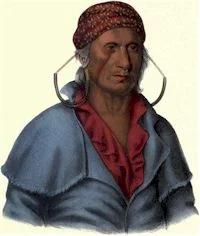
Payta Kootha, Shawanoe Warrior (Shawnee)
Flying Clouds or Captain Reed
The tradition of the
Delawares, as embodied in the
Walam Olum, makes themselves, the Shawnee, and the
Nanticoke, originally one people, the separation having taken place after the traditional expulsion of the Talligewi (
Cherokee)
from the north, it being stated that the Shawnee went south. Beyond
this it is useless to theorize on the origin of the Shawnee or to strive
to assign them any earlier location than that in which they were first
known and where their oldest traditions place them in the Cumberland
basin in Tennessee, with an outlying colony on the middle Savannah in
South Carolina. In this position, as their name may imply, they were the
southern advance guard of the
Algonquian stock.
Their real history begins in 1669-70. They were then living in two
bodies at a considerable distance apart, and these two divisions were
not fully united until nearly a century later, when the tribe settled in
Ohio. The attempt to reconcile conflicting statements without a
knowledge of this fact has occasioned much of the confusion in regard to
the Shawnee. The apparent anomaly of a tribe living in two divisions at
such a distance from each other is explained when we remember that the
intervening territory was occupied by the
Cherokee,
who were at that time the friends of the Shawnee. The evidence afforded
by the mounds shows that the two tribes lived together for a
considerable period, both in South Carolina and in Tennessee, and it is a
matter of history that the
Cherokee
claimed the country vacated by the Shawnee in both states after the
removal of the latter to the north. It is quite possible that the
Cherokee invited the Shawnee to settle upon their eastern frontier in order to serve as a barrier against the attacks of the
Catawba
and other enemies in that direction. No such necessity existed for
protection on their northwestern frontier. The earliest notices of the
Carolina Shawnee represent them as a warlike tribe, the enemies of the
Catawba and others, who were also the enemies of the
Cherokee. In Ramsey’s Annals of Tennessee is the statement, made by a
Cherokee chief in 1772, that 100 years previously the Shawnee, by permission of the
Cherokee, removed from Savannah river to the Cumberland, but were afterward driven out by the
Cherokee, aided by the
Chickasaw,
in consequence of a quarrel with the former tribe. While this tradition
does not agree with the chronological order of Shawnee occupancy in the
two regions, as borne out by historical evidence, it furnishes
additional proof that the Shawnee occupied territory upon both rivers,
and that this occupancy was by permission of the
Cherokee.
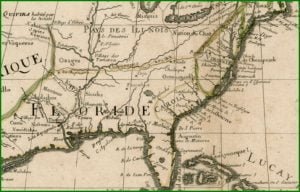
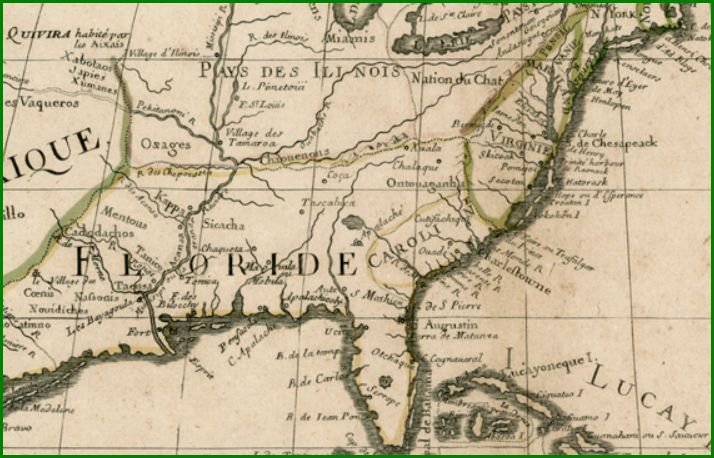
De
l’Isle’s map of 1700 places the “Ontouagannha.” which here means the
Shawnee, on the headwaters of the Santee and Pedee rivers in South
Carolina, while the “Chiouonons” are located on the lower Tennessee
river.
De l’Isle’s map of 1700 places the “Ontouagannha.” which here means
the Shawnee, on the headwaters of the Santee and Pedee rivers in South
Carolina, while the “Chiouonons” are located on the lower Tennessee
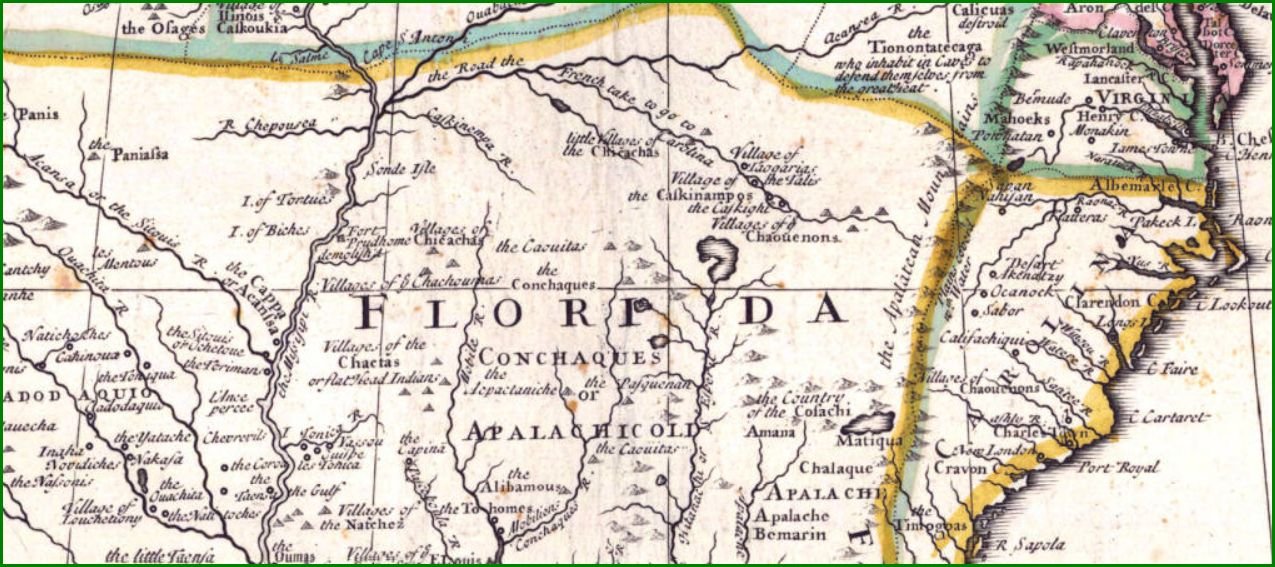
river. Senex’s map of 1710 locates a part of the “Chaouenons” on the
headwaters of a stream in South Carolina, but seems to place the main
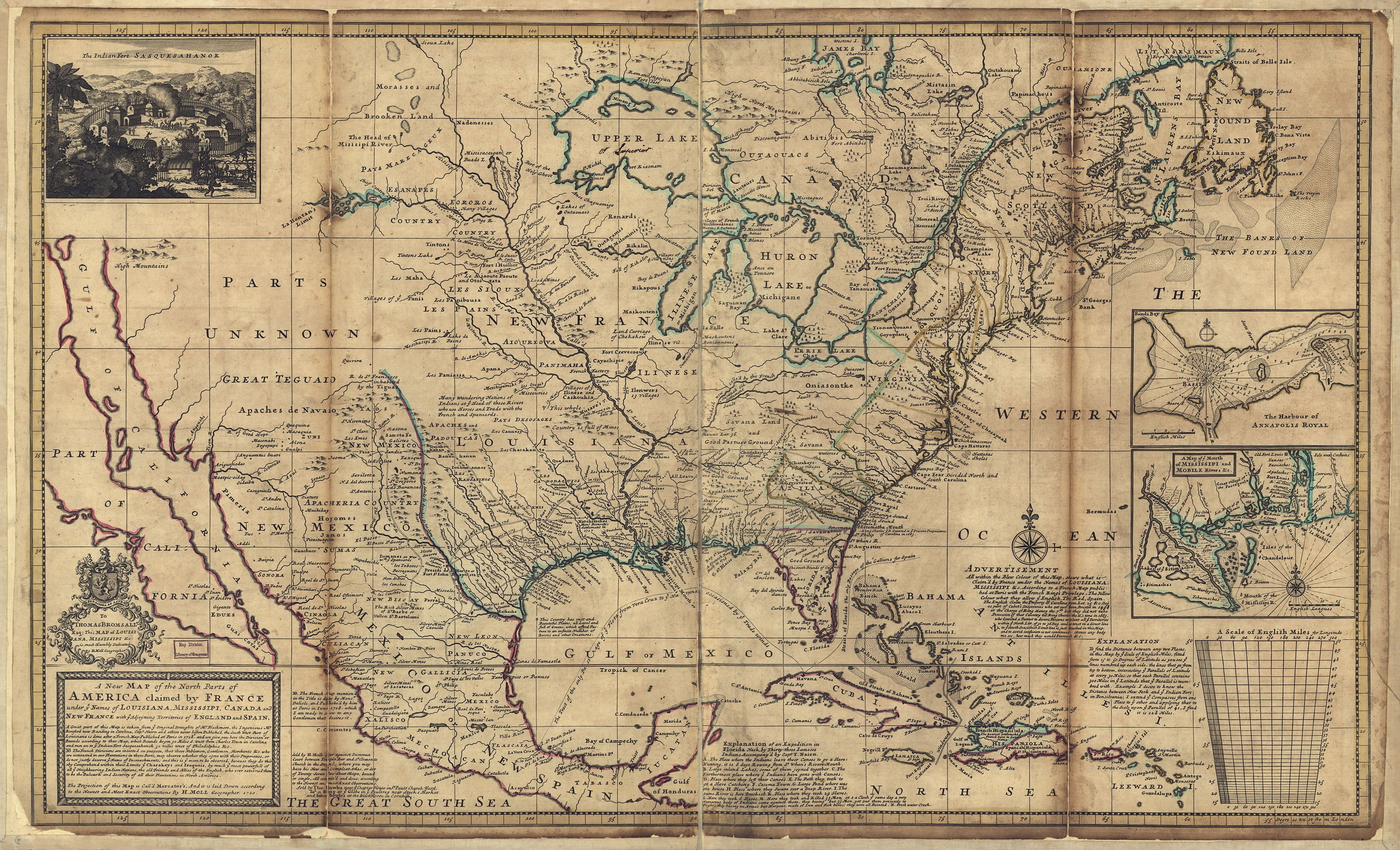
body on the Tennessee. Moll’s map of 1720 has “Savannah Old Settlement”
at the mouth of the Cumberland , showing that the term Savannah was sometimes applied to the Western as well as to the eastern band.
The Shawnee of South Carolina, who included the Piqua and
Hathawekela
divisions of the tribe, were known to the early settlers of that state
as Savannahs, that being nearly the form of the name in use among the
neighboring
Muskhogean tribes. A good deal of confusion has arisen from the fact that the
Yuchi and
Yamasee,
in the same neighborhood, were sometimes also spoken of as Savannah
Indians. Bartram and Gallatin particularly are confused upon this point,
although, as is hardly necessary to state, the tribes are entirely
distinct. Their principal village, known as Savannah Town, was on
Savannah river, nearly opposite the present Augusta, Ga. According to a
writer of 1740
it was at New Windsor, on the north bank of Savannah river, 7 miles
below Augusta. It was an important trading point, and Ft Moore was
afterward built upon the site. The Savannah river takes its name from
this tribe, as appears from the statement of Adair, who mentions the
“Savannah river, so termed on account of the Shawano Indians having
formerly lived there,” plainly showing that the two names are synonyms
for the same tribe. Gallatin says that the name of the river is of
Spanish origin, by which he probably means that it refers to “savanas,”
or prairies, but as almost all the large rivers of the Atlantic slope
bore the Indian names of the tribes upon their banks, it is not likely
that this river is an exception, or that a Spanish name would have been
retained in an English colony. In 1670, when South Carolina was first
settled, the Savannah were one of the principal tribes southward from
Ashley river. About 10 years later they drove hack the Westo, identified
by Swanton as the
Yuchi,
who had just previously nearly destroyed the infant settlements in a
short but bloody war. The Savannah seem to have remained at peace with
the whites, and in 1695, according to Gov. Archdale, were “good friends
and useful neighbors of the English.” By a comparison of Gallatin’s
paragraph with Lawson’s statements from which he quotes, it will be seen that he has misinterpreted the earlier author, as well as misquoted the tribal forms.
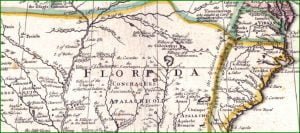
Senex’s
map of 1710 locates a part of the “Chaouenons” on the headwaters of a
stream in South Carolina, but seems to place the main body on the
Tennessee.
Lawson traveled through Carolina in 1701, and in 1709 published his
account, which has passed through several reprints, the last being in
1860. He mentions the “Savannas” twice, and it is to be noted that in
each place he calls them by the same name, which, however, is not the
same as any one of the three forms used by Gallatin in referring to the
same passages. Lawson first mentions them in connection with the
Congaree as the “Savannas, a famous, warlike, friendly nation of
Indians, living to the south end of Ashley river.” In another place he
speaks of “the Savanna Indians, who formerly lived on the banks of the
Messiasippi, and removed thence to the head of one of the rivers of
South Carolina, since which, for some dislike, most of them are removed
to live in the quarters of the
Iroquois or Sinnagars [
Seneca],
which are on the heads of the rivers that disgorge themselves into the
bay of Chesapeak.” This is a definite statement, plainly referring to
one and the same tribe, and agrees with what is known of the Shawnee.
On De l’Isle’s map, also, we find the Savannah river called “R. des
Chouanons,” with the “Chaouanons” located upon both banks in its middle
course. As to Gallatin’s statement that the name of the Savannahs is
dropped after Lawson’s mention in 1701, we learn from numerous
references, from old records, in Logan’s Upper South Carolina, published
after Gallatin’s time, that all through the period of the French and
Indian war, 50 years after Lawson wrote, the “Savannahs” were constantly
making inroads on the Carolina frontier, even to the vicinity of
Charleston. They are described as “northern savages” and friends of the
Cherokee,
and are undoubtedly the Shawnee. In 1749 Adair, while crossing the
middle of Georgia, fell in with a strong party of “the French Shawano,”
who were on their way, under
Cherokee guidance, to attack the English traders near Augusta. After committing some depredations they escaped to the
Cherokee.
In another place he speaks of a party of “Shawano Indians,” who, at the
instigation of the French, had attacked a frontier settlement of
Carolina, but had been taken and imprisoned. Through a reference by
Logan it is found that these prisoners are called Savannahs in the
records of that period. In 1791 Swan mentions the “Savannas” town among
the Creeks, occupied by “Shawanese refugees.”
Having shown that the Savannah and the Shawnee are the same tribe, it
remains to be seen why and when they removed from South Carolina to the
north. The removal was probably owing to dissatisfaction with the
English setters, who seem to have favored the
Catawba
at the expense of the Shawnee. Adair, speaking of the latter tribe,
says they had formerly lived on the Savannah river, “till by our foolish
measures they were forced to withdraw northward in defense of their,
freedom.” In another place he says, “by our own misconduct we twice lost
the Shawano Indians, who have since proved very hurtful to our colonies
in general.” The first loss referred to is probably the withdrawal of
the Shawnee to the north, and the second is evidently their alliance
with the French in consequence of the encroachments of the English in
Pennsylvania.
Their removal from South Carolina was gradual, beginning about 1677
and continuing at intervals through a period of more than 30 years. The
ancient Shawnee villages formerly on the sites of Winchester, Virginia,
and Oldtown, near Cumberland, Maryland, were built and occupied probably
during this migration. It was due mainly to their losses at the hands
of the
Catawba,
the allies of the English, that they were forced to abandon their
country on the Savannah; but after the reunion of the tribe in the north
they pursued their old enemies with unrelenting vengeance until the
Catawba
were almost exterminated. The hatred cherished by the Shawnee toward
the English is shown by their boast in the Revolution that they had
killed more of that nation than had any other tribe.
The first Shawnee seem to have removed from South Carolina in 1677 or
1678, when, according to Drake, about 70 families established
themselves on the Susquehanna adjoining the Conestoga in Lancaster
County, Pennsylvania, at the mouth of Pequea creek. Their village was
called Pequea, a form of Piqua. The Assiwikales (
Hathawekela)
were a part of the later migration. This, together with the absence of
the Shawnee names Chillicothe and Mequachake east of the Alleghanies,
would seem to show that the Carolina portion of the tribe belonged to
the first named divisions. The chief of Pequea was Wapatha, or Opessah,
who made a treaty with Penn at Philadelphia in 1701, and more than 50
years afterward the Shawnee, then in Ohio, still preserved a copy of
this treaty. There is no proof that they had a part in Penn’s first
treaty in 1682.
In 1694, by invitation of the
Delawares and their allies, another large party came from the south probably from Carolina and settled with the
Munsee
on the Delaware, the main body fixing themselves at the mouth of Lehigh
river, near the present Easton, Pennsylvania, while some went as far
down as the Schuylkill. This party is said to have numbered about 700,
and they were several months on the journey. Permission to settle on the
Delaware was granted by the Colonial government on condition of their
making peace with the
Iroquois, who then received them as “brothers,” while the
Delawares acknowledged them as their “second sons,” i. e. grandsons. The Shawnee to-day refer to the
Delawares as their grandfathers. From this it is evident that the Shawnee were never conquered by the
Iroquois, and, in fact, we find the western band a few years previously assisting the
Miami against the latter. As the
Iroquois, however, had conquered the lands of the
Conestoga and
Delawares,
on which the Shawnee settled, the former still claimed the prior right
of domain. Another large part of the Shawnee probably left South
Carolina about 1707, as appears from a statement made by Evans in that
year ,
which shows that they were then hard pressed in the south. He says:
“During our abode at Pequehan [Pequea] several of the Shaonois Indians
from ye southward came to settle here, and were admitted so to do by
Opessah, with the governor’s consent, at the same time an Indian, from a
Shaonois town near Carolina came in and gave an account that four
hundred and fifty of the flat-headed Indians [
Catawba]
had besieged them, and that in all probability the same was taken.
Bezallion informed the governor that the Shaonois of Carolina he was
told had killed several Christians; whereupon the government of that
province raised the said flat-headed Indians, and joined some Christians
to them, besieged and have taken, as it is thought, the said Shaonois
town.” Those who escaped probably fled to the north and joined their
kindred in Pennsylvania. In 1708 Gov. Johnson, of South Carolina,
reported the “Savannahs” on Savannah river as occupying 3 villages and
numbering about 150 men .
In 1715 the “Savanos” still in Carolina were reported to live 150 miles
northwest of Charleston, and still to occupy 3 villages, but with only
233 inhabitants in all.
The
Yuchi and
Yamasee were also then in the same neighborhood .
A part of those who had come from the south in 1694 had joined the
Mahican
and become a part of that tribe. Those who had settled on the Delaware,
after remaining there some years, removed to the Wyoming valley on the
Susquehanna and established themselves in a village on the west bank
near the present Wyoming, Pennsylvania. It is probable that they were
joined here by that part of the tribe which had settled at Pequea, which
was abandoned about 1730. When the
Delawares and
Munsee
were forced to leave the Delaware river in 1742 they also moved over to
the Wyoming valley, then in possession of the Shawnee, and built a
village on the east bank of the river opposite that occupied by the
latter tribe. In 1740 the Quakers began work among the Shawnee at
Wyoming and were followed two years later by the Moravian Zinzendorf. As
a result of this missionary labor the Shawnee on the Susquehanna
remained neutral for some time during the French and Indian war, which
began in 1754, while their brethren on the Ohio were active allies of
the French. About the year 1755 or 1756, in consequence of a quarrel
with the
Delawares,
said to have been caused by a childish dispute over a grasshopper, the
Shawnee abandoned the Susquehanna and joined the rest of their tribe on
the upper waters of the Ohio, where they soon became allies of the
French. Some of the eastern Shawnee had already joined those on the
Ohio, probably in small parties and at different times, for in the
report of the Albany congress of 1754 it is found that some of that
tribe had removed from Pennsylvania to the Ohio about 30 years
previously, and in 1735 a Shawnee band known as Shaweygria
(Hathawekela), consisting of about 40 families, described as living with
the other Shawnee on Allegheny river, refused to return to the
Susquehanna at the solicitation of the
Delawares and
Iroquois.
The only clue in regard to the number of these eastern Shawnee is
Drake’s statement that in 1732 there were 700 Indian warriors in
Pennsylvania, of whom half were Shawnee from the south. This would give
them a total population of about 1,200, which is probably too high,
unless those on the Ohio are included in the estimate.
Having shown the identity of the Savannah with the Shawnee, and
followed their wanderings from Savannah river to the Ohio during a
period of about 80 years, it remains to trace the history of the other,
and apparently more numerous, division upon the Cumberland, who preceded
the Carolina band in the region of the upper Ohio river, and seem never
to have crossed the Alleghanies to the eastward. These western Shawnee
may possibly be the people mentioned in the Jesuit Relation of 1648,
under the name of “Ouchaouanag,” in connection with the
Mascoutens,
who lived in northern Illinois. In the Relation of 1670 we find the
“Chaouanon” mentioned as having visited the Illinois the preceding year,
and they are described as living some distance to the south east of the
latter. From this period until their removal to the north they are
frequently mentioned by the French writers, sometimes under some form of
the collective
Iroquois
name Toagenha, but generally under their Algonquian name Chaouanon. La
Harpe, about 1715, called them Tongarois, another form of Toagenha. All
these writers concur in the statement that they lived upon a large
southern branch of the Ohio, at no great distance east of the
Mississippi. This was the Cumberland river of Tennessee and Kentucky,
which is called the River of the Shawnee on all the old maps down to
about the year 1770.
When the French traders first came into the region the Shawnee had
their principal village on that river near the present Nashville,
Tennessee. They seem also to have ranged northeastward to Kentucky river
and southward to the Tennessee. It will thus be seen that they were not
isolated from the great body of the
Algonquian tribes, as has frequently been represented to have been the case, but simply occupied an interior position, adjoining the kindred
Illinois and
Miami,
with whom they kept up constant communication. As previously mentioned,
the early maps plainly distinguish these Shawnee on the Cumberland from
the other division of the tribe on Savannah river.
These western Shawnee are mentioned about the year 1672 as being harassed by the
Iroquois, and also as allies and neighbors of the Andaste, or
Conestoga, who were themselves at war with the
Iroquois.
As the Andaste were then incorrectly supposed to live on the upper
waters of the Ohio river, the Shawnee would naturally be considered
their neighbors. The two tribes were probably in alliance against the
Iroquois,
as we find that when the first body of Shawnee removed from South
Carolina to Pennsylvania, about 1678, they settled adjoining the
Conestoga,
and when another part of the same tribe desired to remove to the
Delaware in 1694 permission was granted on condition that they make
peace with the
Iroquois. Again, in 1684, the
Iroquois
justified their attacks on the Miami by asserting that the latter had
invited the Satanas (Shawnee) into their country to make war upon the
Iroquois.
This is the first historic mention of the Shawnee evidently the western
division in the country north of the Ohio river. As the Cumberland
region was out of the usual course of exploration and settlement, but
few notices of the western Shawnee are found until 1714, when the French
trader Charleville established himself among them near the present
Nashville. They were then gradually leaving the country in small bodies
in consequence of a war with the
Cherokee, their former allies, who were assisted by the
Chickasaw. From the statement of Iberville in 1702
it seems that this was due to the latter’s efforts to bring them more
closely under French influence. It is impossible now to learn the cause
of the war between the Shawnee and the
Cherokee. It probably did not begin until after 1707, the year of the final expulsion of the Shawnee from South Carolina by the
Catawba, as there is no evidence to show that the
Cherokee took part in that struggle. From Shawnee tradition the quarrel with the
Chickasaw would seem to be of older date. After the reunion of the Shawnee in the north they secured the alliance of the
Delawares, and the two tribes turned against the
Cherokee
until the latter were compelled to ask peace, when the old friendship
was renewed. Soon after the coming of Charleville, in 1714, the Shawnee
finally abandoned the Cumberland valley, being pursued to the last
moment by the
Chickasaw. In a council held at Philadelphia in 1715 with the Shawnee and
Delawares,
the former, “who live at a great distance,” asked the friendship of the
Pennsylvania government. These are evidently the same who about this
time were driven from their home on Cumberland river.
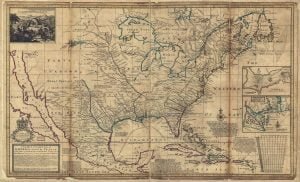
Moll’s
map of 1720 has “Savannah Old Settlement” at the mouth of the
Cumberland, showing that the term Savannah was sometimes applied to the
Western as well as to the eastern band.
On Moll’s map of 1720 we find this region marked as occupied by the
Cherokee,
while “Savannah Old Settlement” is placed at the mouth of the
Cumberland, indicating that the removal of the Shawnee had then been
completed. They stopped for some time at various points in Kentucky, and
perhaps also at Shawneetown, Ill., but finally, about the year 1730,
collected along the north bank of the Ohio river, in Ohio and
Pennsylvania, extending from the Allegheny down to the Scioto. Sawcunk,
Logstown, and Lowertown were probably built about this time. The land
thus occupied was claimed by the
Wyandot,
who granted permission to the Shawnee to settle upon it, and many years
afterward threatened to dispossess them if they continued hostilities
against the United States. They probably wandered for some time in
Kentucky, which was practically a part of their own territory and not
occupied by any other tribe. Blackhoof (Catahecassa), one of their most
celebrated chiefs, was born during this sojourn in a village near the
present Winchester, Kentucky. Down to the
treaty of Greenville, in 1795,
Kentucky was the favorite hunting ground of the tribe. In 1748 the
Shawnee on the Ohio were estimated to number 162 warriors or about 600
souls. A few years later they were joined by their kindred from the
Susquehanna, and the two bands were united for the first time in
history. There is no evidence that the western band, as a body, ever
crossed to the east side of the mountains. The nature of the country and
the fear of the
Catawba
would seem to have forbidden such a movement, aside from the fact that
their eastern brethren were already beginning to feel the pressure of
advancing civilization. The most natural line of migration was the
direct route to the upper Ohio, where they had the protection of the
Wyandot and
Miami, and were within easy reach of the French.
For a long time an intimate connection existed between the
Creeks and the Shawnee, and a body of the latter, under the name of Sawanogi, was permanently incorporated with the
Creeks. These may have been the ones mentioned by Pénicaut as living in the vicinity of Mobile about 1720. Bartram , in 1773, mentioned this band among the
Creeks
and spoke of the resemblance of their language to that of the Shawnee,
without knowing that they were a part of the same tribe. The war in the
northwest after the close of the Revolution drove still more of the
Shawnee to take refuge with the
Creeks. In 1791 they had 4 villages in the
Creek country, near the site of Montgomery, Alabama, the principal being Sawanogi. A great many also joined the hostile
Cherokee about the same time. As these villages are not named in the list of
Creek towns in 1832
it is possible that their inhabitants may have joined the rest of their
tribe in the west before that period. There is no good evidence for the
assertion by some writers that the Suwanee in Florida took its name
from a band of Shawnee once settled upon its banks.
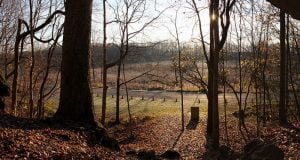
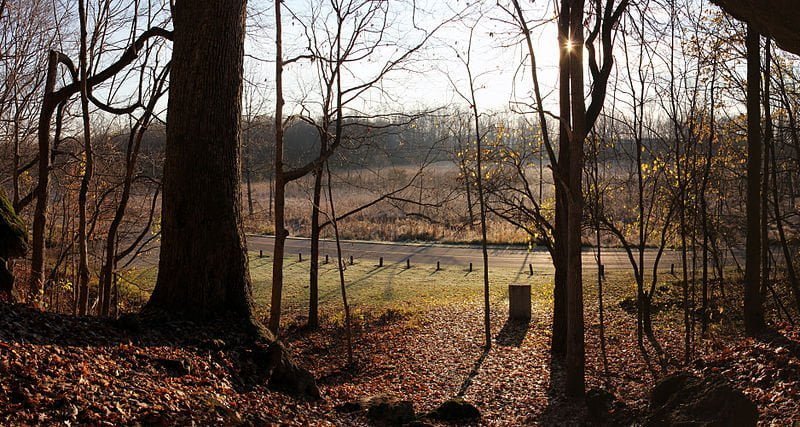
The
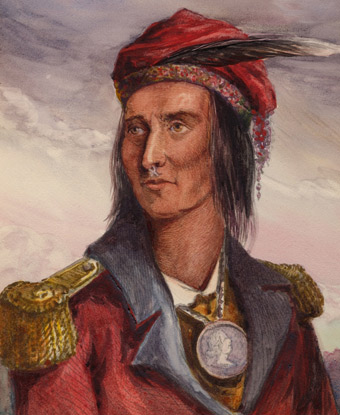
view from Prophet’s Rock, a stone outcropping in rural Tippecanoe
County, Indiana near Battle Ground. The Shawnee leader Tenskwatawa (“The
Prophet”), brother of Tecumseh, sang from this site to encourage his
fellow warriors during the fight against William Henry Harrison’s
soldiers at the Battle of Tippecanoe, November 7, 1811. Photo looks
southeast across Prophet’s Rock Road toward Burnett’s Creek and the
battlefield site beyond.
The history of the Shawnee after their reunion on the Ohio is well
known as a part of the history of the Northwest territory, and may be
dismissed with brief notice. For a period of 40 years from the beginning
of the
French and Indian war to the
treaty of Greenville in 1795
they were almost constantly at war with the English or the Americans,
and distinguished themselves as the most hostile tribe in that region.
Most of the expeditions sent across the Ohio during the Revolutionary
period were directed against the Shawnee, and most of the destruction on
the Kentucky frontier was the work of the same tribe. When driven back
from the Scioto they retreated to the head of the Miami river, from
which the
Miami
had withdrawn some years before. After the Revolution, finding
themselves left without the assistance of the British, large numbers
joined the hostile
Cherokee and
Creeks
in the south, while a considerable body accepted the invitation of the
Spanish government in 1793 and settled, together with some
Delawares,
on a tract near Cape Girardeau, Missouri, between the Mississippi and
the Whitewater rivers, in what was then Spanish territory. Wayne’s
victory, followed by the
treaty of Greenville in 1795,
put an end to the long war in the Ohio valley. The Shawnee were obliged
to give up their territory on the Miami in Ohio, and retired to the
headwaters of the Auglaize. The more hostile part of the tribe crossed
the Mississippi and joined those living at Cape Girardeau. In 1798 a
part of those in Ohio settled on White River in Indiana, by invitation
of the
Delawares. A few years later a Shawnee medicine-man,
Tenskwatawa, known as
The Prophet, the brother of the celebrated
Tecumseh,
began to preach a new doctrine among the various tribes of that region.
His followers rapidly increased and established themselves in a village
at the mouth of the Tippecanoe River in Indiana. It soon became evident
that his intentions were hostile, and a force was sent against him
under Gen. Harrison in 1811, resulting in the destruction of the village
and the total defeat of the Indians in the decisive battle of
Tippecanoe.
Tecumseh was among the
Creeks
at the time, endeavoring to secure their aid against the United States,
and returned in time to take command of the northwest tribes in the
British interest in the
War of 1812. The Shawnee in Missouri, who formed about half of the tribe, are said to have had no part in this struggle. By the death of
Tecumseh in this war the spirit of the Indian tribes was broken, and most of them accepted terms of peace soon after. The
Shawnee in Missouri sold their lands in 1825
and removed to a reservation in Kansas. A large part of them had
previously gone to Texas, where they settled on the headwaters of the
Sabine river, and remained there until driven out about 1839 (see
Cherokee). The Shawnee of Ohio
sold their remaining lands at Wapakoneta and Hog Creek in 1831, and joined those in Kansas. The mixed band of
Seneca and Shawnee at Lewistown, Ohio, also removed to Kansas about the same time.
A large part of the tribe left Kansas about 1845 and settled on
Canadian river, Indian Territory (Oklahoma), where they are now known as
Absentee Shawnee. In 1867 the Shawnee living with the
Seneca
removed also from Kansas to the Territory and are now known as Eastern
Shawnee. In 1869, by inter-tribal agreement, the main body became
incorporated with the
Cherokee Nation
in the present Oklahoma, where they are now residing. Those known as
Black Bob’s band refused to remove from Kansas with the others, but have
since joined them.
For Further Study
The following articles and manuscripts will shed additional light on the Shawnee as both an ethnological study, and as a people.
- Shawnee Indians – Swanton
- Creek Confederacy – Swanton
- Shawnee Treaties
- Treaty of January 31, 1786
- Treaty of August 3, 1795
- Treaty of June 7, 1803
- Treaty of July 4, 1805
- Treaty of November 25, 1808
- Treaty of July 22, 1814
- Treaty of September 8, 1815
- Treaty of September 29, 1817
- Treaty of September 17, 1818
- Treaty of November 7, 1825
- Treaty of July 20, 1831
- Treaty of August 8, 1831
- Treaty of October 26, 1832
- Treaty of December 29, 1832
- Treaty of May 10, 1854
- Agreement of September 13, 1865
- Treaty of February 23, 1867
- Shawnee Tribal Locations
- Indian Missions of Middle Atlantic States
- Native American Land Patents
- Wyandot and Shawnee Indian Lands
- Free US Indian Census Schedules 1885-1940
- Quapaw Agency
- Eastern Shawnee
- Seneca Agency
https://www.accessgenealogy.com/native/shawnee-tribe.htm
Piqua Shawnee
piquashawnee.com