Showing posts with label Delaware. Show all posts

Thursday, September 27, 2018

Shawnee Indian - Kansas

William G. Cutler's
History of the State of Kansas
was first published in 1883 by A. T. Andreas, Chicago, IL.

http://www.kancoll.org/books/cutler/deschist/indhistp5.html#EMIGRANT_TRIBES

The Missouri Shawnees were the first Indians removed to the territory set apart for emigrant tribes by the treaties of June, 1825, with the Kanzas and Osages. By treaty made at St. Louis, November 7, 1825, the United States granted "to the Shawnee tribe of Indians within the State of Missouri, for themselves, and for those of the same nation now residing in Ohio who may hereafter emigrate to the west of the Mississippi, a tract of land equal to fifty miles square, situated west of the State of Missouri, and within the purchase lately made from the Osages."

The tract of fifty miles square thus granted, as afterward surveyed and conveyed to the tribe by deed May 11, 1844, was bounded as follows: "Beginning at a point in the western boundary of the State of Missouri, three miles south of where said boundary crosses the mouth of Kansas River, thence continuing south and coinciding with said boundary for twenty-five miles; thence due west 120 miles; thence due north until said line shall intersect the southern boundary of the Kanzas Reservation; thence due east, coinciding with the southern boundary of said reservation, to the termination thereof; thence due north, coinciding with the eastern boundary of said reservation, to the southern shore of the Kansas River; thence along said southern shore of said river to where a line from the place of beginning, drawn due west, shall intersect the same."
1854-map
Map Kansas 1854
The Shawnees had their ancient home in the basin of the Cumberland River. Their territory was invaded by the Iroquois about the year 1672, and the vanquished Shawnees, fleeing to the South, were scattered over various parts of the country--settling in the Carolinas, at the head-waters of the Mobile River, in Florida, and it is related that one tribe had "quite gone down to New Spain." After a short time, several of the tribes re-united and returned to the vicinity of their old hunting-grounds, forming settlements in the valley of the Ohio, where Father Marquette relates that they were "in such numbers that they seem as many as twenty-three villages in one district, and fifteen in another, lying quite near each other."

Several treaties of peace had been made previous to 1786, with the Shawnees, in common with other tribes, but that of January 31, 1786, was the first concluded with them separately as a nation. By the provisions of this treaty, which was made at the mouth of the Great Miami River, on the northwest bank of the Ohio, the United States allotted to the Shawnees certain lands on the Miami River, contiguous to the reservations of the Wyandots and Delawares, in consideration of which the Shawnees, relinquished "all title, or pretense of title, they ever had to the lands east, west and south of the east, west and south lines before described."

The Wyandots protested against this treaty, on the ground that the lands set apart for the Shawnees had been previously, by treaty, ceded to themselves. The Shawnees remained, however, on the land, sharing the Wyandot hunting and fishing grounds, and it was in consideration of their forbearance at this time that the latter tribe requested the Shawnees to cede to them a portion of their reservation in the Indian Territory, when they attempted to negotiate for removal from Sandusky in 1832.
From the time of the treaty of peace which the Shawnees made with William Penn in 1682 (the first treaty with the whites to which they were a party), the Society of Friends took an intelligent and constant interest in their welfare. Thomas Chalkley, a minister of the London society of the denomination, who visited them as early as 1706, mentions among the peculiarities of the nation its custom of admitting women to its councils. He says: "In the council was a woman who took a part in the deliberations of this council, as well as upon all important occasions.

"On the interpreter being questioned why they permitted a woman to take so responsible a part in their councils, he replied that some women were wiser than some men, and that they had not done anything for years without the council of this ancient, grave woman, who spoke much in this council."

Philanthropic and religious enterprises were necessarily suspended during the long-continued French, English and Indian wars, but after the close of the war of 1812, the Friends again resumed their labors among the Shawnees, establishing a school, and building flour and saw mills at their village in Ohio. Under the prudent and energetic superintendence of Henry Harvey, the tribe made rapid advance in civilization, and in the year 1831, when their lands were bought by Government, preparatory to the removal of the tribe to the West, the Ohio Shawnees were prosperous in an eminent degree.
January 4, 1793, Baron De Carondelet, a Spanish nobleman, granted to bands of Shawanoes and Delawares who desired to settle there, a tract of land about twenty miles square, "lying between the River St. Come and Cape Geredeau, and bounded on the east by the Mississippi, and westwardly by White Water."

The Delawares removed from the tract in 1815; the Shawnees removed from their first location near the cape, and again removed as white settlers encroached on their lands, until, by the treaty of November 7, 1825, they relinquished all title to their Missouri lands, and removed to their reservation in what is now the State of Kansas. In 1831, a treaty was concluded with the Ohio Shawnees, giving them a certain sum for their improvements in that State, and land contiguous to the Missouri Shawnees in Indian Territory. A portion of the tribe removed in 1832; the remainder, in the fall of the following year.

The good results of the habits of thrift and industry which these Shawnees had acquired, aided and encouraged by the influence of the missionaries, who soon settled among them in their new location, were, after a few years, apparent in the comparatively comfortable houses and the well-cultivated fields which multiplied on their reservation.

An act was passed in 1853, granting the Ohio Shawanoes $66,000 additional compensation for their improvements in that State--twenty years after their removal. This sum was paid to the Ohio band at their reservation in Kansas.

On May 10, 1854, the tribe ceded to the United States the entire tract set apart for them November 7, 1825, and conveyed to the tribe by deed, May 11, 1844, containing about 1,600,000 acres, and by a provision of the same treaty, the United States retroceded to the tribe "200,000 acres to be selected between the Missouri State line and a line parallel thereto and west of the same thirty miles distant, which parallel line shall be drawn from the Kansas River to the southern boundary line of the country herein ceded."

Three sections of land were to be set apart to the Missionary Society of the Methodist Church South; 320 acres to the Friends' Shawnee Labor School; 160 acres to the American Baptist Missionary Union; five acres to the Shawnee Methodist Church; and two acres to the Shawnee Baptist Church--all to be considered a part of the retroceded 200,000 acres. The residue of the tract was to be divided, each individual receiving 200 acres, to be deeded in fee simple, and whatever remained to be set apart for any other Shawnees who might thereafter unite with the tribe.

The privilege of selecting lands extended to every head of a family who, though not a Shawnee, had legally married into the nation, according to their customs, all persons adopted into the tribe, all minor orphan children of Shawnees, and all incompetent persons, to have selections made adjacent to their friends and relatives.

Other provisions were as follows: "In the settlement known as Black Bob's Settlement, in which he has an improvement, whereon he resides, and in that known as Long Tail's Settlement, in which he has an improvement, whereon he resides, there are a number of Shawnees who desire to hold their lands in common; it is therefore agreed that all Shawnees, including the persons adopted as aforesaid, incompetent persons, and minor children who reside in said settlements, and all who shall, within sixty days after the approval of the surveys hereinafter provided for by the United States, signify their election to join either of said communities and reside with them, shall have a quantity of land assigned and set off to them in a compact body, at each of settlements aforesaid, equal to 200 acres to each individual in each of said communities."
"Piqua Shawnee"
Piqua Shawnee
Piqua Shawnee Tribe

Monday, September 17, 2018

History Of The Shawnee: Part 3

PART 3:
As published in the Official Newsletter of the Piqua Shawnee (Fall 2018)
By Barbara Lehmann, Piqua Shawnee Tribal Historic Preservation Officer
 
Barbara’s History Corner:
 
Bezallion informed the governor that the Shaonois of Carolina he was told had killed several Christians; whereupon the government of that province raised the said flat headed Indians, and joined some Christians to them, besieged and have taken, as it is thought, the said Shaonois town.” Those who escaped probably fled to the north and joined their kindred in Pennsylvania. In 1708 Gov. Johnson, of South Carolina, reported the “Savannahs” on Savannah River as occupying 3 villages and numbering about 150 men 6. In 1715 the “Savanos” still in Carolina were reported to live 150 miles northwest of Charleston, and still to occupy 3 villages, but with only 233 inhabitants in all.

A part of those who had come from the south in 1694 had joined the Mahican and become a part of that tribe. Those who had settled on the Delaware, after remaining there some years, removed to the Wyoming valley on the Susquehanna and established themselves in a village on the west bank near the present Wyoming, Pennsylvania. It is probable that they were joined here by that part of the tribe which had settled at Pequea, which was abandoned about 1730. When the Delawares and Munsee were forced to leave the Delaware River in 1742 they also moved over to the Wyoming valley, then in possession of the Shawnee, and built a village on the east bank of the river opposite that occupied by the latter tribe. In 1740 the Quakers began work among the Shawnee at Wyoming and were followed two years later by the Moravian Zinzendorf. As a result of this missionary labor the Shawnee on the Susquehanna remained neutral for some time during the French and Indian war, which began in 1754, while their brethren on the Ohio were active allies of the French. About the year 1755 or 1756, in consequence of a quarrel with the Delawares, said to have been caused by a childish dispute over a grasshopper, the Shawnee abandoned the Susquehanna and joined the rest of their tribe on the upper waters of the Ohio, where they soon became allies of the French. Some of the eastern Shawnee had already joined those on the Ohio, probably in small parties and at different times, for in the report of the Albany congress of 1754 it is found that some of that tribe had removed from Pennsylvania to the Ohio about 30 years previously, and in 1735 a Shawnee band known as Shaweygria (Hathawekela), consisting of about 40 families, described as living with the other Shawnee on Allegheny river, refused to return to the Susquehanna at the solicitation of the Delawares and Iroquois. The only clue in regard to the number of these eastern Shawnee is Drake’s statement that in 1732 there were 700 Indian warriors in Pennsylvania, of whom half were Shawnee from the south. This would give them a total population of about 1,200, which is probably too high, unless those on the Ohio are included in the estimate.

Having shown the identity of the Savannah with the Shawnee, and followed their wanderings from Savannah river to the Ohio during a period of about 80 years, it remains to trace the history of the other, and apparently more numerous, division upon the Cumberland, who preceded the Carolina band in the region of the upper Ohio river, and seem never to have crossed the Alleghanies to the eastward.
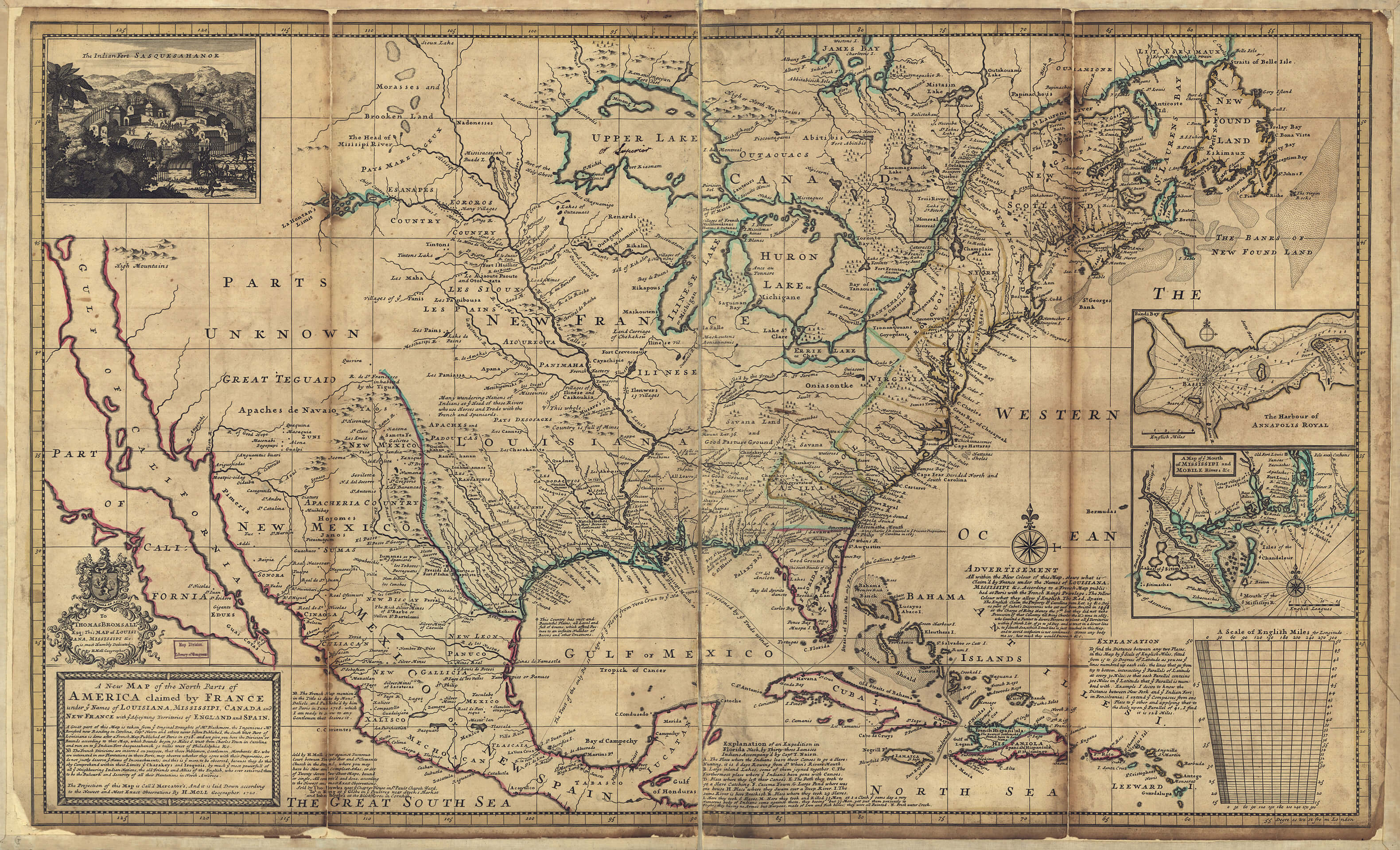
Moll-Map-of-1720-small
Moll’s map of 1720 has “Savannah Old Settlement” at the mouth of the Cumberland, showing that the term Savannah was sometimes applied to the Western as well as to the eastern band
These western Shawnee may possibly be the people mentioned in the Jesuit Relation of 1648, under the name of “Ouchaouanag,” in connection with the Mascoutens, who lived in northern Illinois. In the Relation of 1670 we find the “Chaouanon” mentioned as having visited the Illinois the preceding year, and they are described as living some distance to the south east of the latter. From this period until their removal to the north they are frequently mentioned by the French writers, sometimes under some form of the collective Iroquois name Toagenha, but generally under their Algonquian name Chaouanon. La Harpe, about 1715, called them Tongarois, another form of Toagenha. All these writers concur in the statement that they lived upon a large southern branch of the Ohio, at no great distance east of the Mississippi. This was the Cumberland River of Tennessee and Kentucky, which is called the River of the Shawnee on all the old maps down to about the year 1770.

 
When the French traders first came into the region the Shawnee had their principal village on that river near the present Nashville, Tennessee. They seem also to have ranged northeastward to Kentucky River and southward to the Tennessee. It will thus be seen that they were not isolated from the great body of the Algonquian tribes, as has frequently been represented to have been the case, but simply occupied an interior position, adjoining the kindred Illinois and Miami, with whom they kept up constant communication. As previously mentioned, the early maps plainly distinguish these Shawnee on the Cumberland from the other division of the tribe on Savannah River.

These western Shawnee are mentioned about the year 1672 as being harassed by the Iroquois, and also as allies and neighbors of the Andaste, or Conestoga, who were themselves at war with the Iroquois. As the Andaste were then incorrectly supposed to live on the upper waters of the Ohio River, the Shawnee would naturally be considered their neighbors. The two tribes were probably in alliance against the Iroquois, as we find that when the first body of Shawnee removed from South Carolina to Pennsylvania, about 1678, they settled adjoining the Conestoga, and when another part of the same tribe desired to remove to the Delaware in 1694 permission was granted on condition that they make peace with the Iroquois. Again, in 1684, the Iroquois justified their attacks on the Miami by asserting that the latter had invited the Satanas (Shawnee) into their country to make war upon the Iroquois. This is the first historic mention of the Shawnee evidently the western division in the country north of the Ohio River. As the Cumberland region was out of the usual course of exploration and settlement, but few notices of the western Shawnee are found until 1714, when the French trader Charleville established himself among them near the present Nashville. They were then gradually leaving the country in small bodies in consequence of a war with the Cherokee, their former allies, who were assisted by the Chickasaw. From the statement of Iberville in 1702 8 it seems that this was due to the latter’s efforts to bring them more closely under French influence. It is impossible now to learn the cause of the war between the Shawnee and the Cherokee. It probably did not begin until after 1707, the year of the final expulsion of the Shawnee from South Carolina by the Catawba, as there is no evidence to show that the Cherokee took part in that struggle.

From Shawnee tradition the quarrel with the Chickasaw would seem to be of older date. After the reunion of the Shawnee in the north they secured the alliance of the Delawares, and the two tribes turned against the Cherokee until the latter were compelled to ask peace, when the old friendship was renewed. Soon after the coming of Charleville, in 1714, the Shawnee finally abandoned the Cumberland valley, being pursued to the last moment by the Chickasaw. In a council held at Philadelphia in 1715 with the Shawnee and Delawares, the former, “who live at a great distance,” asked the friendship of the Pennsylvania government. These are evidently the same who about this time were driven from their home on Cumberland river.

To Be Continued Winter 2018
 
Piqua Shawnee Tribe
"Piqua Shawnee"